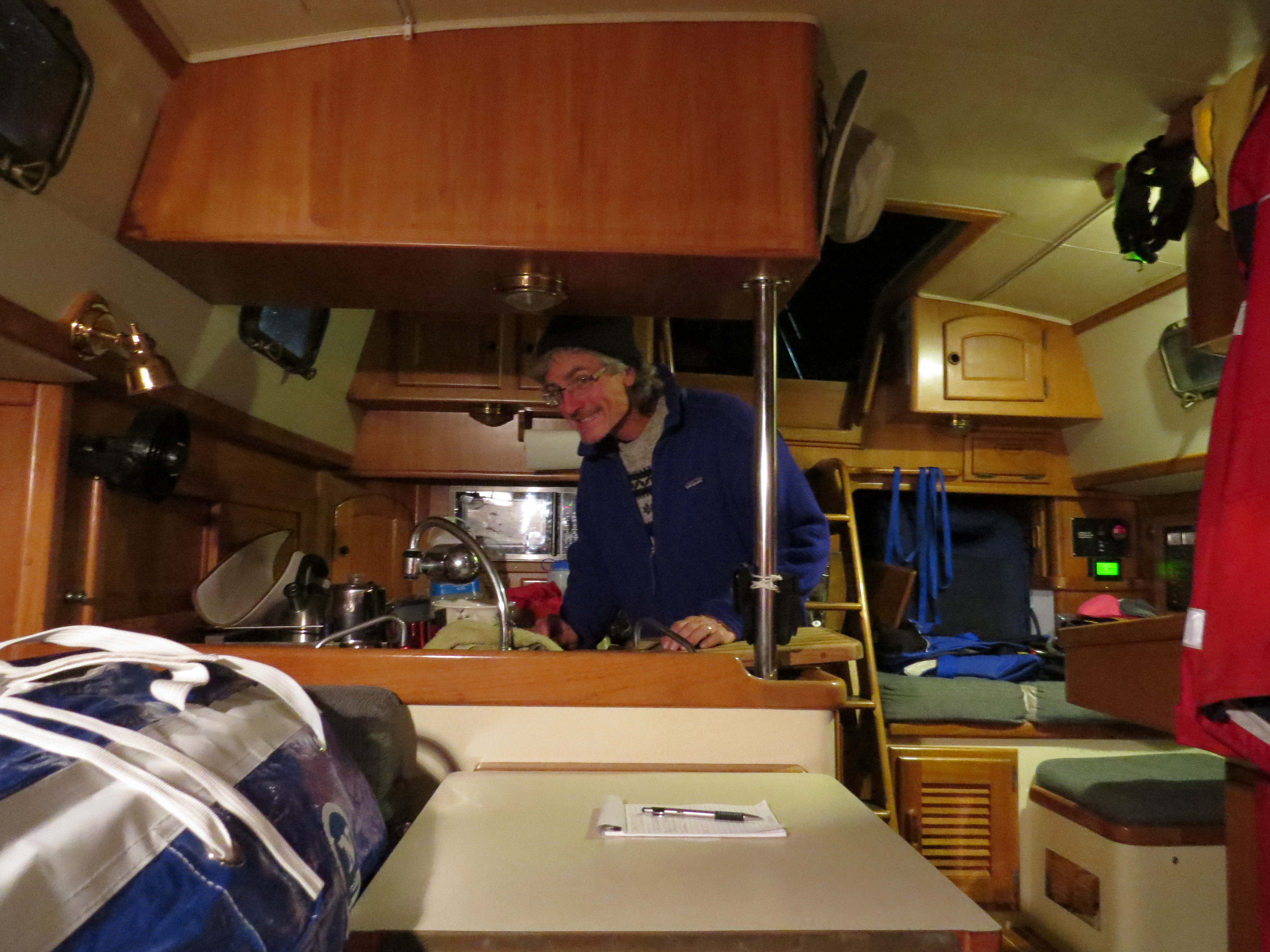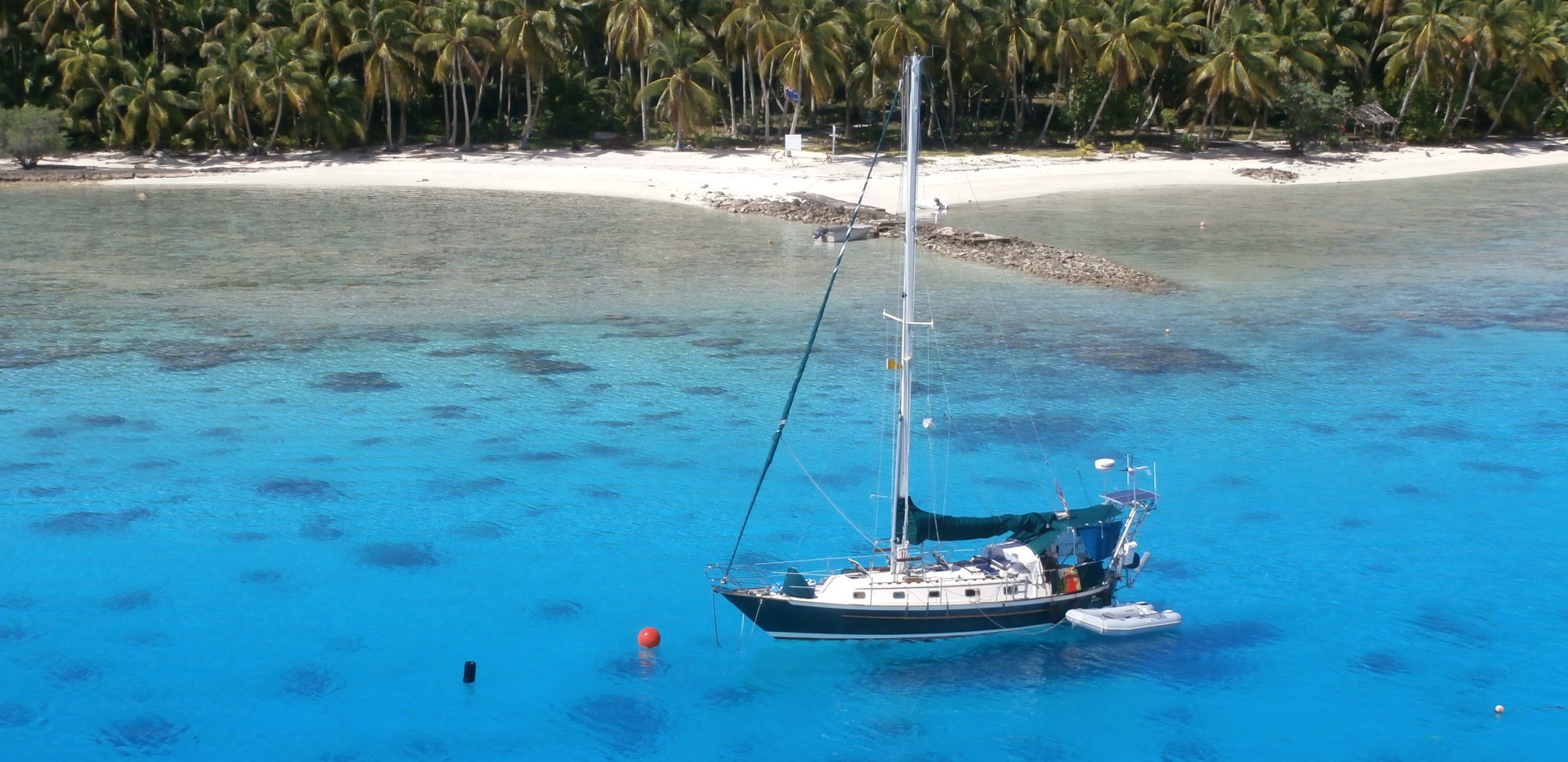
The Pacific Puddle Jump

It is the storm before the calm once more.  As we make preparations for the 3000-mile run from Mexico to French Polynesia we bear more resemblance to ants running amok than sun-tanned cruisers relaxing in paradise.

Pam flies back to California to visit old friends, check up on Little Bear, and pick up a few thousand dollars of boat parts.  The friends treat her like a hero returning home from the Trojan wars.  Little Bear licks her hand and wonders where the rest of his pack, me, Lindsay, Julian, have gone to.  The boat parts fill several duffle bags and weigh over a hundred pounds but provide me with the satisfaction of knowing that these aspects of the boat will never fail — because if you have a spare starter motor it is your bilge pump that fails, not your starter, and if you have a spare bilge pump it is your alternator that fails, and not because these are related in any way, but because Murphy’s Law states that the parts that will fail are the ones for which you carry no spares.

Abandoned onboard Pamela at the scorching marina in La Cruz de Huanacaxtle I am left for eleven days to my various vices.  I decide to get a ham radio license by memorizing the answers to 750 exam questions such as “What is the peak-inverse-voltage across the rectifiers in a full-wave bridge power supply?”  I don’t actually need a ham license to talk to other sailors in the South Pacific on my single-sideband radio, but being a ham will give Pam more assurance that I know what I’m doing when I pick up the radio.  Besides, if we run into a whale and I need to send a MAYDAY I can chat with other hams while the ship is going down.

MAYDAY, MAYDAY, this is KK6KMH sending a CQ for all ships.  We’re sinking.  And by the way, did you know that a mixer is the circuit used to process signals from the RF amplifier and local oscillator and send the result to the IF filter in a superheterodyne receiver?

I study like a madman for a solid week, day and night, refusing all offers to drink tequila and eat tacos with my friends on the dock.  I read the study guides for the Technician Class and General Class Licenses, the two levels required to become a full-fledged ham.  I run through the 750 questions five times.  I begin having dreams about capacitors and the ionosphere, my brain turns to soft oatmeal, and I stumble into the testing center at Nuevo Vallarta with red-blotched eyes and bad breath.  I score 100% and the Technician and 97% on the General.  Overkill.

Elated with my achievement and seeking balance I return to the boat and turn my attention to my next challenge.  Is it possible to drink all the Pacifico beer from the marina tienda before Pam gets back in town?

In between sips I change the oil in the diesel and replace the fuel filters.  I poke around in the aft quarter below decks to top up the transmission fluid and stare at the steering cables and autopilot.  I service the watermaker, changing its filters and “pickling” it to prevent nasty organic crap from piling up on the membrane while the boat is sitting in the marina for the next couple of weeks.  I pour all the diesel from the jugs up on deck into the fuel tank and refill the jugs with fresh diesel.  José on the dock agrees to take my old gasoline for free, and I fill the gas tank for the outboard with fresh gas and add a fuel stabilizer, some to the gas tank and some down my pant leg.  I attach a new swivel to my big forward anchor and attach new control lines to the Monitor self-steering windvane I’ve affectionately named Monte.  My calculations show that I can purchase two tall-boys of Pacifico each day and return the bottles for a grand total of $4.80 which would allow me to work on the boat and drink beer in perpetual motion in perpetuity.

I need a break from the boat preparation work so I get some cold beer and move into the air-conditioned cruiser’s lounge in the yacht club and start working on my income taxes.  After a couple of marathon sessions I manage to file my federal and state income taxes and drain several thousand dollars from my retirement fund to help pay for US military might and budgetary deficits.  A small portion of the money will go to roads, an even smaller portion to public libraries, with a couple bucks left to pay for public schools.  The tax form gives me a chance to donate a dollar to the president’s re-election fund, which works out to about half of what goes to the schools, so I politely decline.

Now it is time to attack the brightwork.  The varnish on Pamela’s teak has been peeling like an onion since we entered the tropics, and I’m going to put an end to this abomination.  Robyn on Mintaka tells me to leave all the teak alone and just let it go natural.  Carlann on Pacific Breeze tells me I’m working too hard and all the people in the marina are feeling lousy. But I won’t listen, and instead bring out the heat gun to begin stripping a decade of varnish from the rubbing strakes and cap rails.  The Mexican sun burns down on my head in harmony with my heat gun.

Everyone comes by to have a look.  You can’t apply even a stroke of varnish in a marina without attracting the attention of every advice giver within a nautical mile.  Many are helpful and some may offer you a handy tool.  And then there are small minority who insist on your following their advice to the point of belligerence.

Ian on Salish Sea is one of the helpful ones.  He offers me his scraping tools and a file to keep them sharp.  He shows me how to sharpen them with the file.  After a day of using them he comes by with an orbital sander.  The day after that he returns with a six-pack of Pacificos and we drink them slowly in the cockpit while I show him how to play blues riffs on guitar.

Pam calls to give me an ultimatum — there had better not be any varnish smells on the boat when she returns next week.  I am working from first light to dusk on the varnish, now on day four for this job, but it is not enough.  I need to get into seriously high gear.  I pick up a couple more tall-boys and apply varnish like never before.  Carlann continues to tease me about my slavish work ethic, but soon she is whistling and complimenting the new shine on Pamela’s brightwork.  I vow to have seven coats of fresh varnish on Pamela’s teak before Pam returns.  I am now up to six coats.  She returns in two days.  There is no stopping for a break.  Two more tall-boys of Pacifico, wet-sanding every surface before applying the next coat, I am a man possessed, an obsessive-compulsive bundle of firing synapses.  Like my insane studying for the ham license, this varnishing project reveals yet another example of trout-farm work ethic gone awry.  Perhaps more Pacificos can bring balance.

At last the job is finished.  Pamela’s clean decks are gleaming in the tropical sun.  I tell my friends on the dock that this fresh varnish will help us sail faster in the South Pacific trade winds, less friction and all that.  They stare back at me, too diplomatic to state what they are thinking, which is this:  You’re about to head off across the South Pacific.  Don’t you have more important things to do to get the boat ready rather than varnish the brightwork?

Soon Pam is back on board.  Her trip to California has been fabulous and she has eaten at all the best restaurants in the Bay Area.  The boat is spotless and the Pacifico bottles are all gone.  She dumps the boat parts onto Pamela’s uncluttered saloon floor and looks around.  “Looks good,” she says.  “Smells bad.  Have you been breathing all these toxins?”

The last week crawls by.  I am anxious to sail across the South Pacific, but there its still lots to do, stowing all the gear, more trips to the market for provisions, starting the process for clearing out of the country, cleaning Pamela’s bottom, informal seminars at the yacht club about fixing your rigging, avoiding onboard fires, and how to successfully jump into your life raft when the boat is sinking.  Larry, our crew for the Pacific Puddle Jump, arrives with his guitar.  He has lined up several gigs in town and we go see him play with various groups in La Cruz.  He lets me sit in on a few numbers and I belt out a handful of Van Morrison songs and find harmonies to blend with Larry’s voice and his virtuoso guitar playing.

I’m up the mast doing one last rigging inspection when the officials arrive to clear us out of the country.  Four men come onboard, including a customs official, two immigration officials, and a representative from the Port Captain’s office.  We leave the marina for a couple days in the anchorage getting our sea legs back.  Having gone to the top of the mast, I now take the opportunity to dive down to the ship’s keel.  I am satisfied to find the mast head and keel are right where they should be.

We have a bit of a misadventure the last day in La Cruz.  It is a Thursday, the day when fresh produce arrives at the tienda in town, and Pam has ordered lots of produce along with Robyn on Mintaka.  We need to pick up all this produce, including eight dozen very fragile eggs, but we are anchored out after officially clearing out of the country, not in the marina.  This is a bit of a logistical problem given that our dinghy and kayak are all stowed for the long journey ahead.  Mintaka has two dinghies, a rubber one stowed below and a hard dinghy on deck, so Mark from Mintaka and I form a plan:  Mark is to row the hard dinghy, a stout little ship, along with Pam and Robyn, over to the marina dock, then proceed into town to the tienda to get the multiple cases of fruits, vegetables, and eggs, and then I am to take Pamela to the fuel dock to pick up Pam, Mark, Robyn, and the load of produce.

The dinghy arrives at Pamela according to plan to pick up Pam, and Mark is heaving heavily on her oars through a boisterous chop raised by a stiff afternoon breeze.  The little boat is quite full with three passengers and bags for carrying the produce, and off they go through the rough water.  I give them sufficient time to pick up the produce, then raise Pamela’s anchor and drive her into the harbor and up to the fuel dock, which closes at 7:00 p.m., and now it is 6:45.  The gate to the fuel dock will close promptly at 7:00 so the operation has to go very smoothly or we will be cut off from getting all the produce on board.

But landing at the fuel dock to pick up passengers is not actually allowed, so I make as if to take on fuel.  My tanks, of course, are already chock full, but I’m able to take on three litres.  A nearby power boat is taking on 1000 litres.  The fuel dock girl smiles at me.  She is a doll, quite pretty in her short-shorts and make-up, not at all what you might expect at a Mexican fuel dock.  How the pangeros must stare!  She is not phased by my three litres, but her boss in the kiosk at the end of the pier is suspicious and calls over a fuel dock official.  He arrives with his assistant right behind Mark and Pam carrying bags of produce while Robyn settles the bill with the van driver who they hired to drive them the two blocks to the pier.  Caught red-handed we are subjected to his questioning, primarily “How many people are you?”, a question that seems odd to me until I realize that he is going to charge us a fee for each person.  The fee is 350 pesos, about $30 US.

Robyn, who is good in Spanish and loathe to spend 350 pesos unfairly, makes our case to the official.  The debate goes on for some time before the expressions on the faces of the two officials shows Robyn is winning her argument.  But the officials must save face, and soon we all arrive at a happy compromise.  There will be no fee for Pamela, but we must pay 40 pesos (a couple bucks) for tying the dinghy to the fuel dock pier.  I am delighted to leave Mexico for only 40 pesos, avoiding the customs, immigrations, and Port Captain officials who would not be happy to find us at the fuel dock after clearing out, because clearing out officially means leaving the country right then and there and not hanging out at anchor and fiddling about with produce and fuel.
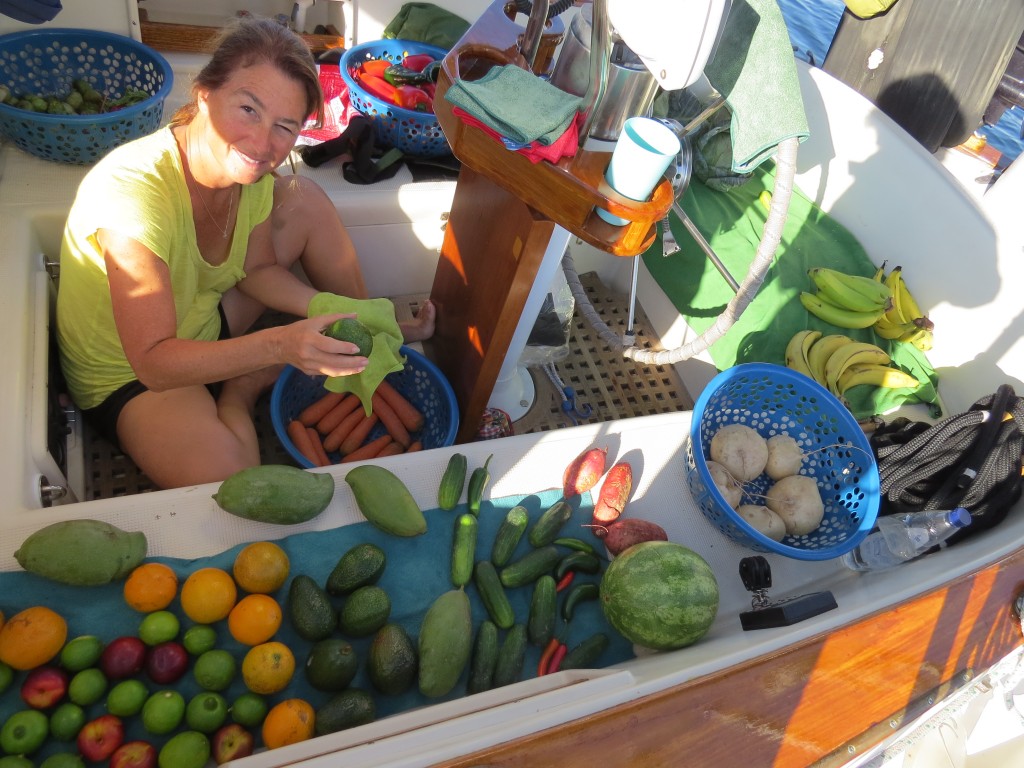
 

With Pamela’s fuel tanks filled beyond the top and her cockpit strewn with several weeks of apples, tomatoes, potatoes, eggs, and more, I wave goodbye to the fuel dock girl who waves cheerfully back at me, while Mark pulls at his dinghy’s oars and offers to race me back to the anchorage.  The chop and breeze are gone and the evening is now tranquil, making it easy to divide up the produce and ferry Mintaka’s portion over to her.  We sit one last evening in La Cruz anchorage, watching the sun set and feasting on roast chicken and red wine with Mark and Robyn, who we hope to remain relatively close to all the way to the Marquesas.

And now the time has come that I have been looking forward to for more than thirty years.  It is time to raise Pamela’s anchor, trim her sails, and point her bow to the southwest.  At last we are bound for French Polynesia!  We check email one last time, count how many dollars are left in the bank account, and make one last website post to announce to the world that we are off and away.

Mintaka is resting at anchor a short distance away.  I raise Pamela’s anchor and while I am busy securing the anchor to the deck with extra lashes I notice that Mintaka has slipped her cables and is away.  She is ahead of us!  We raise our sails and begin to fly in the morning breeze but Mintaka maintains her lead.  I attempt to catch her as we glide past Las Tres Marietas islands but she is too fast with her jib, staysail, main, and mizzen.

And then — rotten luck — we hook a skipjack on the hand line and slow Pamela down a notch to reel in and then release the skipjack, for the crew is in no mood for a greasy-tasting jack just yet.  Ten minutes later — worse luck — we hook a big jack cravalle on the rod and reel and slow Pamela even more.  I have been warned that the jack cravalle is a disgusting fish to eat, so we attempt to release him.  But he is hooked too well.  While the skipjack was only lightly hooked and swam away with much vigor when I released him, the big jack cravalle is badly hooked and is laying upon his side like a heavy sea anchor.  It takes twenty minutes to reel him in, and by then he is all done in.  I  work quickly to free him from the hook but he is caught by his gills.  He is bleeding and his gills are nearly ripped out before I have him off the hook.  I feel truly bad about releasing him half-dead.  I am reminded of a botched goat-killing when I was fourteen on the trout farm, when my .22 rifle bullet went astray.  It is a grim memory and haunts me throughout the morning,

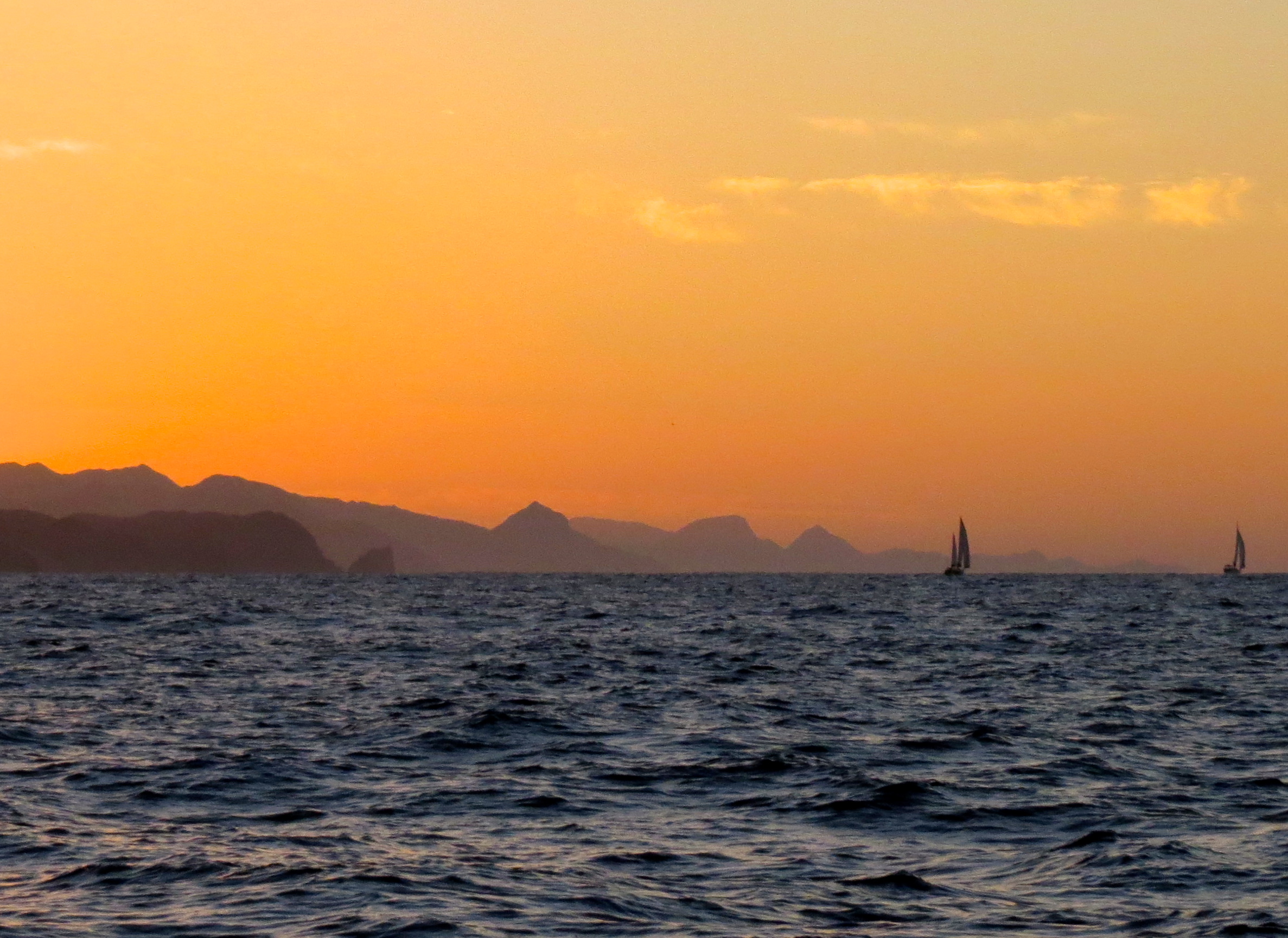
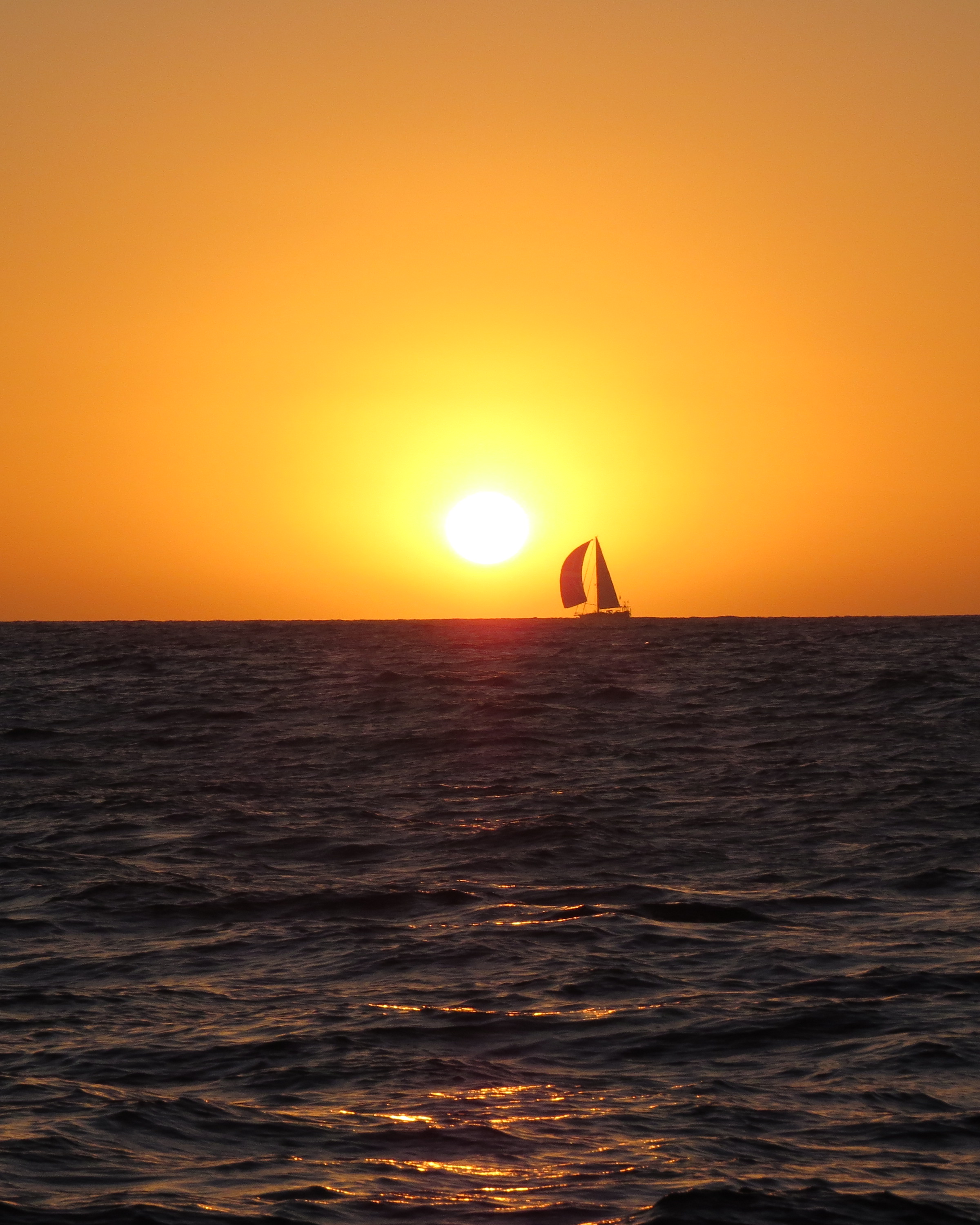
As the red sun sets off of Pamela’s bow the full yellow moon rises synchronously off her stern.  It is a good omen for our long trip.  The moon illuminates the horizon all around and its silver trail on the wave tops eventually moves around to the west as the night wears on, giving me a path to steer by.  At midnight a pod of porpoises joins our bow wave.  I hear their gasps of air and watch them play for a while in our bow wake.  Happy dolphins.  A good omen indeed.

On day two the wind freshens and the waves become steep.  The decks are awash and salt spray is everywhere.  On watch in the cockpit, we wear our foul-weather gear, jacket and pants, and wait with clenched teeth between cold splashes of salt water.  Pamela is rolling deeply in the troughs while the contents of her lockers go banging through the night.  I wait in grim anticipation for two dozen cans of turkey meat to crack through Pamela’s hull and six-packs of San Pellegrino mineral water to shatter in the cockpit lazarette.  But the cargo holds.  As bad as it sounds, the ship is solid and does not hole nor capsize in the confused seas.  Meanwhile, Pamela runs at seven knots directly to her first waypoint, latitude 6 degrees north and longitude 130 degrees west, 1700 miles away at the beginning of the Inter-Tropical Convergence Zone (i.e., the doldrums near the equator).

On day three we are becalmed.  The boiling seas have marched off to the southwest and we are left with a warm, calm, sunny day.  We open the hatches and enjoy the fresh air coming through the cabin.  We sit on deck in our swim trunks while our foul-weather clothing dries.  I am mesmerized by the clear blue water under our stern, calm as a swimming pool, stabbed by yellow shafts of sunlight penetrating down hundreds of feet below the smooth surface.  To celebrate the fine weather Pam makes fried chicken and garlic mashed potatoes for dinner.  I am awakened at 0200 by Larry scraping the pot for another spoonful of mashed potatoes, and Pam is awakened two hours later by me doing the same.

Pamela’s systems are all working well, the solar panels, the wind generator, the SSB radio, and the watermaker.  But the watermaker takes lots of amperage from the battery so we have to run the engine every day to make a few gallons of fresh water.  Running the engine means burning up precious diesel since the solar panels and wind generator do not produce enough electricity to keep up with the watermaker and the refrigerator.  I try to keep all these variables in my head but its a complex formula.  I’m nervous about having enough diesel, especially since our cruising guide says that occasionally there are shortages of fuel in the Marquesas.

Pam wants me to fill more water jugs for emergency purposes.  We have 100 gallons in our tanks, five gallons in an emergency jug on deck, and five or six gallons in jugs down below.  Plus a couple quarts in our ditch bag and a can or two in our life raft survival kit. I remember reading various accounts of shipwreck victims in life rafts who have to drink their own urine to survive.  Why do all life raft stories begin like that?  I don’t want to drink my own urine, nor anyone else’s urine for that matter.  So I dutifully fill more empty jugs.

On day four on midnight watch I am startled by a loud gasp from the water a couple of yards from where I sit in the cockpit.  The sound of breathing is eerily human in the dark night.  A large pod of porpoises, a dozen or more, are arcing through the waves.  I see their dark fins come to the surface, while their tails make bursts of phosphorescence.  They glide with grace.  I imagine that I am speaking telepathically to them.  I imagine that they have come from far away just to say hello to me in the dead of night.

On day five it is Pam’s birthday.  Alas, I have no gift other than my presence, our floating home, and a love letter I write to her at midnight.  We set the hand line at dawn, and by midmorning there is a fish on the line.  Another jack?  Hopefully not!  It turns out to be a beautiful fifteen-pound yellow-fin tuna.  We land it easily on Pamela’s coaming and watch the sensational rainbow-colored skin while the poor fish completes its death throes.  Pam sends the fish positive vibes of gratitude.  The cockpit is soon covered in soaking blood, fish parts, and red filets.  By lunchtime the cockpit is clean and we are eating chilled sashimi with wasabi and pickled ginger.  We will feast on this tuna for several days, enjoying seared ahi and fried eggs for breakfast, sushi for two or three lunches, and teriyaki tuna for three dinners.  It is a wonderful birthday present.

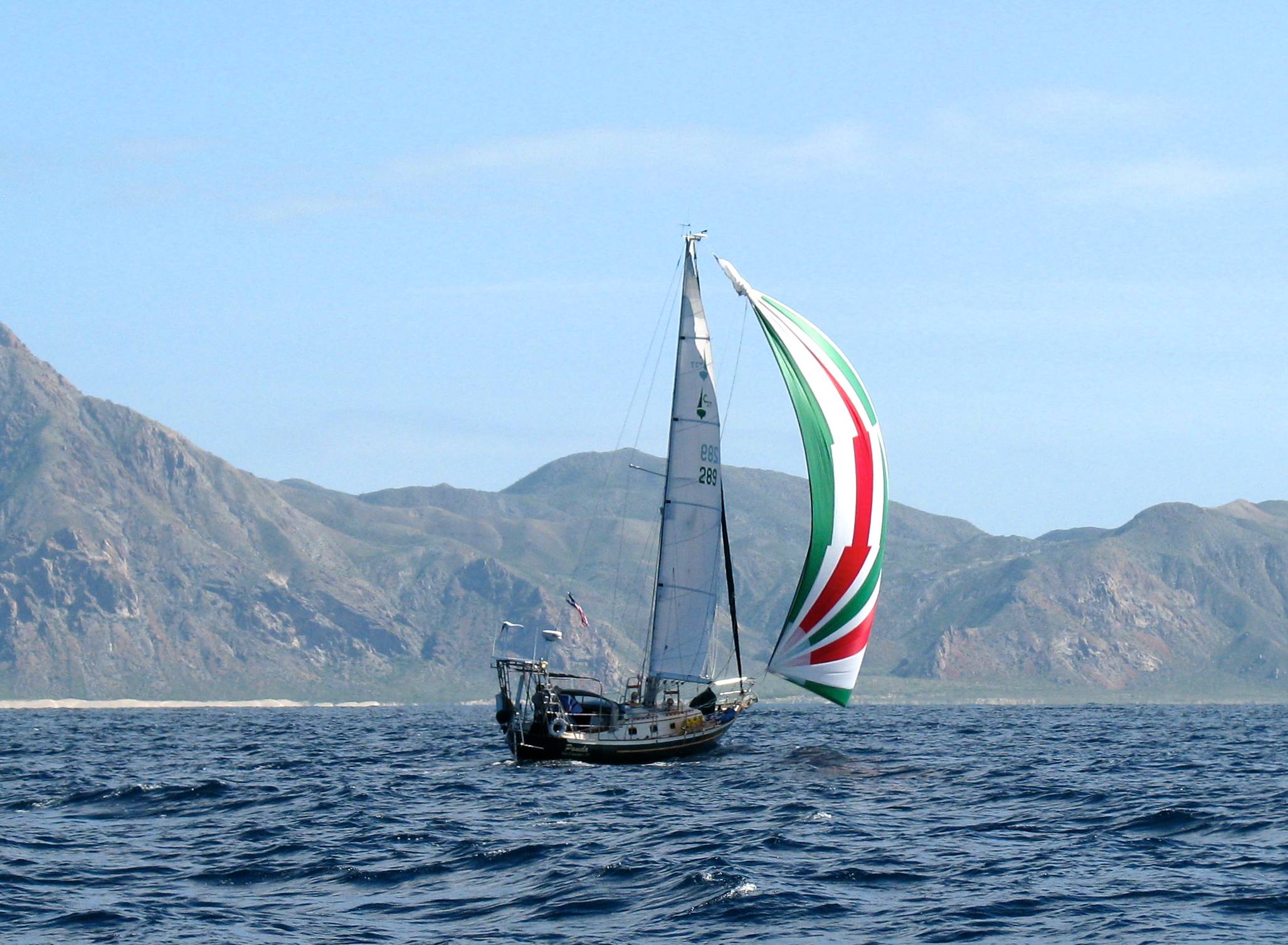
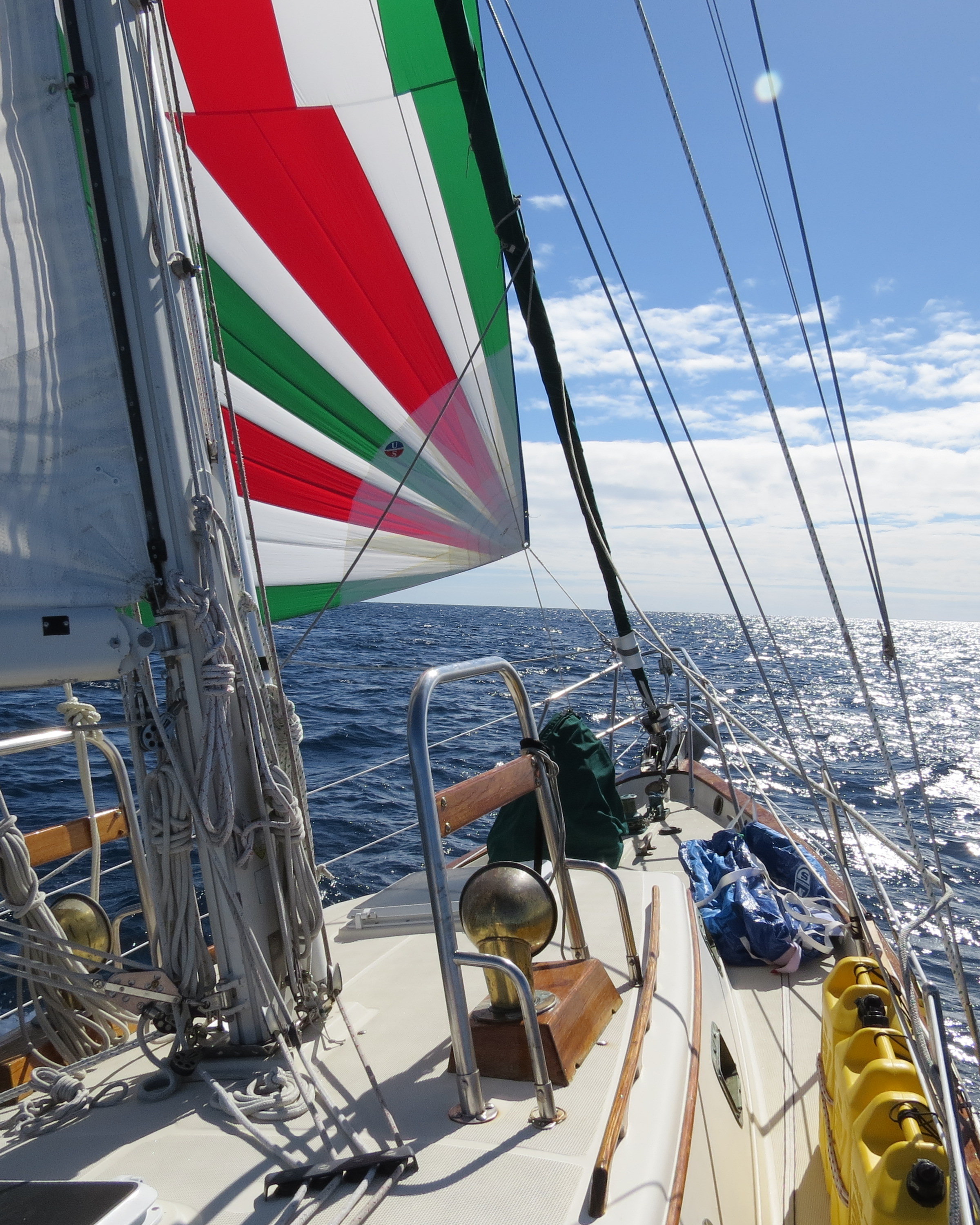
On day six we get the spinnaker flying.  The wind is perfect, about ten knots, the sea is mostly flat, and Pamela glides over the waves at six knots, the definition of glorious sailing.

Then the lazy sheet wraps itself around the bow light and pitches it through the air.  A moment later I am staring at it in Pamela’s wake, still floating.  We snatch down the spinnaker, sheet in the main, and turn into the wind across our back trail to try and find the bow light.  A man-overboard setting on the chart plotter shows about where the bow light made its plunge, with an icon on the screen in the shape of a person flailing in the water with his arms in the air.  But with three pairs of eyes we are unable to find the bow light, which probably sank or floated off to join a million other bits of flotsam in the Great Pacific Gyre.  I am seriously bummed.  It’s not the first time my bow light has gone flying — I smashed it into a pier at Catalina, then ripped it off with a spinnaker sheet off the Baja California coast — and I’m running out of wire to attach it back to the boat.

But who needs a bow light 700 miles out to sea?  There is no one here to see it.  That evening, without the bow and stern lights burning bright, I find a boiling trail of phosphorescence off Pamela’s stern.  I try to imagine how Pamela must appear to porpoises swimming far below her in the crystal-clear blue water with the shimmering strands of bioluminescence streaming along her bows, weather strake, and rudder.  Like a comet!  I lay for hours on Pamela’s port rail staring at the glowing streaks as waves are pushed by her bows, then turn over onto my back to watch the stars high above her mast.  The moon tonight is waning, rising three hours after the setting sun, and with long cumulonimbus clouds covering half the sky the night appears black.  When the moon finally rises above the clouds it shines with an intensity that causes the stars to fade.  Once again its silver trail illuminates the wave tops and beckons me to follow.  In my watch from 0400 to 0600 I steer Pamela directly into the well-lit moonbeam highway.

Day seven is a blustery day.  The sky is overcast, the wind is strong from the north-east, and the seas are rough.  We bounce along and are thrown about the cabin as we putter about on various chores and contemplate how to reduce our energy consumption.  We are running the engine for an hour each day to keep up with the refrigerator and navigation equipment.  Soon we will shut down the refrigerator for a few hours each day as we use up our frozen meat, and hopefully we will not need to run the engine so much.  Our cruising guides tell us that the diesel supply is unpredictable in the Marquesas since it has to be carried in by the monthly supply ship Ara Nui and the locals get first rights to it.  We may need to make our fuel last all the way to Tahiti, some 1500 miles beyond the Marquesas.  So we need to run the engine sparingly, keeping our batteries topped up with the solar panels and wind generator and casting our fate to the vagaries of wind and cloud cover.

On day eight the decks are awash in flying fish.  They range in size between a plump ten inches and a scant single inch.  I find over a dozen on the weather side as I take my morning stroll around the deck.  The crew refuses an offer of fried eggs and flying fish for breakfast.  I am reading Sailing Alone Around The World on my night watch, and I relate how Captain Joshua Slocum finds flying fish on Spray’s decks each morning and prepares them for his breakfast.  In 1896 Captain Slocum is the first man ever to sail around the world alone in a small boat.  Soon we will be following his path through the islands of the South Pacific.  His boat, the Spray, is exactly the length of Pamela, 36 feet 9 inches from stem to stern.  Reading this book 30 years ago I was captivated by Slocum’s adventures and decided I would one day follow in his wake.

But I can’t quite bring myself to fry up these bloated flying fish, stiff from rigor mortis and baking in the scuppers.  Pam tempts me with cold fresh yogurt and sweet pears instead.

On day nine I awaken in a foul mood.  The day is grey and the clouds are low.  The ocean has been a washing machine since midnight and the seas can not decide whether they are northerly or easterly.  A big swell from the north hits Pamela hard on the side while Pam, Larry, and I are finishing breakfast in the cockpit.  Cold salt water spills down our shirts and onto the cockpit seats to soak our pants.

After the big wave Pam finds a “ring-ding” on the cockpit floor.  The job of this particular ring-ding is to hold a cotter pin in place, and the job of the cotter pin, in turn, is to hold some vital part of the rig from falling down.  I pick up the prodigal ring-ding and examine it closely.  It is a big one.  It is there — rather, was there — to hold something particularly important.  Now it is no longer holding.  I need to find out where, and right away.

I begin a systematic sector search of the mast and boom, then the various blocks holding halyards, sheets, vangs, and traveller.  Everything that needs a ring-ding seems to have one securely in place.  And none of the existing ring-dings are anywhere close to the size of this mystery ring-ding.  From where did it come?

Back on the dock in San Francisco I would occasionally find a nut or washer on deck.  After an extensive search and no findings I would decide that it came from another sail boat in the marina.  Sure — a curious gull found it on Johnny M’s boat, scooped it up as a kind of scavenger hunt prize, then dropped it onto Pamela’s foredeck as a mischievous prank.  I would not rule out the possibility of Johnny M himself putting a loose washer in Pamela’s scupper.  That might explain his perpetual Cheshire Cat grin.

But out here on the high seas I am unable to blame the lone ring-ding on another boat.  We did see a fishing boat at daybreak, and it is certainly possible that the roving ring-ding could have been carried by a porpoise pod from the fishing boat to Pamela.  And I wouldn’t rule out entirely the extraordinarily tiny possibility that Johnny M himself is behind this ring-ding business.  But even here on the wide ocean where the fertile mind tends to invent apparitions and hallucinations, I can not convince myself that a sea-faring ring-ding flew over from a passing ship or a puckish Johnny M.

And then I remember Monte the windvane.  Of course!  Monte steers the boat night and day with precision and trustworthiness you would never find in human form.  A missing ring-ding from a shieve, spindle, or pulley in Monte’s complex array of mechanical parts would be the undoing of us all, for steering the boat is something we do only for a few minutes as sport rather than necessity around the clock.  I am horrified to find a ring-ding on the windvane exactly the size of the wayward ring-ding.  But my frantic inspection shows that all of Monte’s parts, ring-dings included, are in place and functioning with reliability.

My search is exhausted and there is not a scrap of evidence.  I place the ring-ding on the chart table and try to forget it.  But as I move around the cabin the evil ring-ding stares at me like sinister eyes in a portrait of a brooding great-grand-uncle hanging in a dank basement.  At last I hide the ring-ding under the log book.

It whispers to me in the midnight witching hour:  “Find my pin.  Find my shackle.  The mast is tottering ….”

I need help.  I decide to call in the big guns.  I put it out there for the universe.  There is lot of universe out here indeed.  I get my angels working on it.  I meditate on the ring-ding and ask the spirits to point me to where it came from.

And then, like a spotlight on the sails in the midnight dog-watch the answer is clear and the mystery is solved.  The lower lifeline I found hanging loose a few days ago and repaired with a spare nut and bolt!  Suddenly I am transformed into Inspector Columbo unwinding the mystery:  the lifeline ring-ding somehow unravelled in the rocking and vibration of the boat, its pin was washed over the side while the ring-ding lay in the scupper; the rogue wave washed the ring-ding out of the scupper, over the coaming, and onto the cockpit sole where Pam discovered it.

So the mast is not tottering after all, nor is Monte on the brink of failure.  And with this blazing, and admittedly obvious, revelation I sink into my bunk and begin to snore.

On day ten I ponder.  Foremost on my mind is the filthy state of my body and habitat.  A boat at sea is a somewhat grubby environment, with salt-encrusted cockpit, a plethora of dead flying fish and squid on the side decks, and a galley that reveals just how far that can of tomato sauce was tossed when a breaking wave slapped hard against the starboard beam while Pam was preparing spaghetti sauce.  I ponder the flaking of my salt-saturated scalp and the hole on my crown that is developing from a case of chronic bed-head.  I ponder my navel, now full of tiny bits of blue tarp trapped within it.  (That ancient blue tarp that we discovered in a forgotten lazarette which disintegrated within minutes of putting it to use.)  I am captivated by the myriad oils that my body produces in all of its parts both public and private.  I am appalled at the distinct possibility of an outbreak of swamp-ass, or worse, Inter-Tropical Convergence Zone ball rot.

A fresh water shower in the cockpit, with copious hot water heated by the diesel engine, washes away all of these horrible ailments in minutes and leave me feeling fresh with an awakened vitality.  And then the cycle repeats and the pondering continues.

Mostly I ponder on the enormous effort that we as a culture exert each day to keep ourselves from devolving into this state of disgrace I find myself in on the down-cycle.  Essentially, all of our effort to do well in school, go to a good college, get a well-paying job, and show up to work every day for 40 years is for a single purpose:  to prevent our falling into this natural state of filthiness.  We need to shower daily.  So we need a home with a mortgage and plenty of hot water, and we need to purchase various soaps, powders, shampoos, and deodorants, and we need a car to get us to the local mega-supermarket.  We need to keep the home and the car clean as well, for the Second Law of Thermodynamics, entropy, conspires to cover them gradually in the grime that we hope will never reach our bodies.  Finally, we need to spend hours scrubbing it all — mornings and evenings in the bathroom scrubbing, shaving, and flossing ourselves, Saturdays spent wiping down and disinfecting the bathroom, and Sundays spent washing the car.  There is just barely enough time before and after work each day to do it all.  When do we have time to write a poem, learn French, or play guitar?  We trade self-cleanliness for self-actualization.

Not so on a boat at sea.  I wear the same pants every day, and when I’m smelling like a flying fish I point the cockpit shower nozzle at each of the directions of my body-compass and blast away, first with my pants on and then with them off.  After a few blasts my pants and I are clean, Godly, and vital.

It is only a matter of a minute or two before a wave crests over the spray skirt and covers me with salt, or a flying squid lands in my lap and squirts his ink on my clean pants.  Alas, the sea and its creatures are conspiring and colluding to make me an integral part of their world.  Why fight it?  If I can learn to accept this all as an essential part of the journey, I might find peace in the simple harmony of the wind and sea.

On day eleven we find ourselves on the same tack for the past 48 hours.  We haven’t touched a sail for over two days.  Pamela is careening along over bumpy seas with 18-22 knots of fresh north east wind.  Long, low cumulonimbus clouds threaten to rain, which we long for.  And then finally the shower comes — a glorious torrent of fresh water carrying away the salt from our bodies, sails, and decks!  I peel off my soggy gym shorts and scamper nude across the foredeck, feeling the warm rain against my salty skin.  I am amused by the contrast between deep tan and Puritan pale, and celebrate the moment by singing gospel songs at the top of my voice as the squall blows sideways sheets of rain into my face.

We are almost at the halfway point, nearly 1400 miles from Mexico and 350 miles from the doldrums, or Inter-Tropical Convergence Zone (ITCZ).  I have been studying the weather charts for the past six weeks to see how the trade winds converge around the equator in these seas.  My strategy is to aim the boat at six degrees north latitude and 130 degrees west longitude to reach the point where the north east trades meet the south east trades, with almost no dead air between them.  But now the weather charts tell me that this area will become a large zone of disturbed air flow in 72 hours.  Winds are forecast at four knots, a far cry from the 20 knots that are currently rocking and rolling us ever south.  If this forecast comes true we may sit for days in light air and rolling seas with our sails slatting and tempers souring.  We may be forced to fire up the engine to motor 150 miles or so through this awful zone.  For now, we point our bow to our imaginary waypoint at the ITCZ and cross our fingers.

On day twelve we are soaking in streams of rain.  The squalls hit us hour by hour and wash away all the salt and grime.

I stumble into the cockpit at 0600 and realize I am on a careening train with its wheels just barely holding onto the tracks.  It rocks wildly from side to side down a steep mountainside.  The sparks fly in a dazzling array where its wheels find friction on the slippery rails, becoming bioluminescence as the tracks gradually turn into the sea and the train is Pamela.  I am groggy from a deep sleep and a weird dream.  For the first time in thirteen days I don’t know where I am when I awaken in the dark cabin.  There is no moon and few stars.  Pamela speeds into the black night as I write these words.

The sun does not rise.  The sky becomes a kaleidoscope of grays, light gray in the east and dark gray where the storm clouds hover.  My spirits brighten considerably when Pam pulls a hot brioche from the oven and we attack it with great globs of butter.  She has been kneading the dough and patiently letting it rise on the swinging gimballed stove, all day long rising and swaying as tall waves toss us about.  The fresh baked bread is delicious, soft and fluffy, not at all like the hard-tack I practiced making all summer in preparation for this voyage.  Tomorrow we’ll have toasted brioche and fried plantains for breakfast — yum!

The wind begins to fizzle so we set the whisker pole to hold out the jib to keep it from slatting.  In the hour before dawn the wind is on the rise again and I go forward to take down the pole.  I haven’t done this alone before, and certainly not in the dark.  But all goes well and I have the pole safely stowed as the wind freshens.  I am safely back in the cockpit now and the wind is starting to blow hard.  I look between the shrouds and see the Southern Cross low on the horizon.  Its four stars twinkle, then one by one they slowly disappear, snuffed out by a low lying cloud.

On day thirteen we are soaking in rivers of rain.  My foul weather gear is soaked through.  I go up on deck dry and naked, then layer by layer put on my water-logged gym shorts, dripping shirt, soaked rain pants and jacket.

As I study the weather charts I feel like a seamstress threading my way through highs and lows.  Yesterday’s chart looked dismal, forecasting that in 72 hours Pamela would drift in the middle of a 200-mile-wide high pressure zone with little or no wind.  Today I see a different pattern developing, projecting that we will enjoy fifteen knot winds as we enter the convergence zone

Pam creates the most wonderful scones conceived by the imagination of poets, crusty and hot and filled with currants.  They are overwhelmingly delightful as we munch on them in the rainy cockpit.

Deep in the doldrums and ahead of us by 100 miles, Mintaka motors for twelve hours looking for wind.  We have no shortage of wind so far, with frequent squalls through the day and night.

On day fourteen we are soaking in oceans of rain.  I capture some of it on video as Pamela, with sun on her decks, approaches a sky so purple-black that it quails the heart.  I pass the time doing sit-ups, push-ups, and down-dog Yoga postures on the foredeck, oblivious to the spray and rain.  The day is brightened considerably as Pam pulls a hot Tuscan loaf out of the oven, her third bread of the voyage.  It is soft and moist and reminiscent of Perugia and San Geminiono.  Simply marvelous!

Still 100 miles ahead of us, Mintaka is motoring with a adverse current that limits her progress to two knots.  Our wind turns from east to southwest, directly from the direction from Hiva Oa, and forces us westward for a time.  Ah, the doldrums.

Day fifteen is a good day for washing and drying.  The rain squalls have ceased for a time and there are beautiful cumulous clouds on the horizon hinting at a spell of fair weather.  I remove all the sheets, towels, foul weather gear, and damp rags from the saloon and hang them around the boat.  Monte complains when the bed sheets hanging from the clothesline spoil the airflow to the windvane and Pamela begins to sail in circles.  Then come the chart books that have been lying in a damp place on the floor, and next come my various spiral-bound notebooks that have taken in the damp from the humid equator.  Soon Pamela is festooned in waving flags of laundry.  She sails on proudly in seven knots of breeze, keeping her sails full and drawing and making three knots through the gentle equatorial waters.

We may need to turn on the engine soon.  Mintaka, now well over 120 miles southeast of us, has motored over 24 hours through the ITCZ so far, but Pamela is still finding enough breeze to keep her moving along.

On day sixteen I am visited by a dolphin pod during my midnight watch.  Pamela is sailing finely and churning up long tendrils of phosphorescence, which the dolphins see and hear from a great distance.  They streak through the black water like torpedoes making their own trails of phosphorescence.  They play for a few minutes and then disappear into the starlit night.

On day seventeen we are becalmed.  We talk of crossing the equator soon.  A sliver of moon appears as the sun sets.  On days eighteen and nineteen we are becalmed for a while, then set upon by gusty little gales as dark clouds pass overhead and dump rain down on our salty decks.  On day twenty the winds have finally blown themselves out and can no longer drive the sails.  The sky is cloudy with frequent rain that brings no wind.  The sails are slatting.  Unable to hold any wind they fill briefly and then collapse.  They crack loudly as they swing back and forth and test the strength of the standing rigging and our nerves.  We take this punishment for a while, then drop the sails and motor for twelve hours, then repeat the process, slatting then motoring.  We talk of one day crossing the equator.  Ah, the doldrums.

Pam once again brings hope to the crew by baking fresh bread — this time a light loaf with spiced pumpkin seeds and Mexican habiñero peppers!

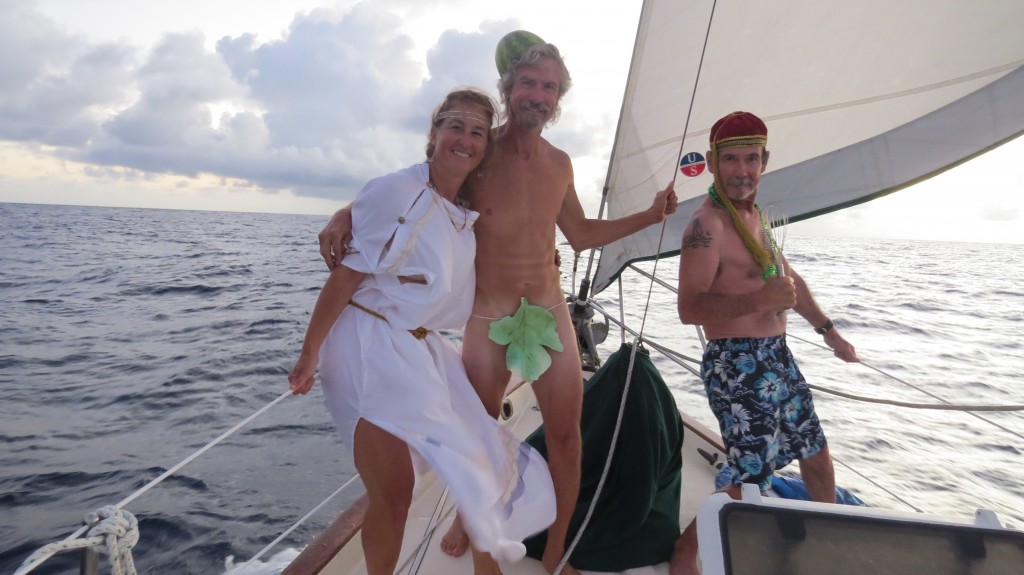
On day twenty-one we have been at sea for three weeks.  But today there is a new exuberance —  we are preparing to cross the equator at last!  This is not an easy thing to plan for.  You have to do it just right or there could be consequences.  Typically there is someone on the boat who has crossed previously — a “shellback”.  Those on board who have not crossed previously are “pollywogs.”  The shellback dresses up like King Neptune and performs an initiation ceremony to turn the fresh pollywogs into seasoned shellbacks.  But in our case, everyone on board is a pollywog, so we have to improvise without a Neptune.  Pam dresses up in her Greek Goddess outfit, a gorgeous white gown exposing a sexy calf and ankle.  Larry is stripped to his waist and sports a red velvet fez with a gold and silk tassel, complemented by a Saint Patrick’s Day necklace and a kitchen whisk.  I go simple.  Naked (again?  really?) with a green fig leaf made of watercolor paper and a half a watermelon on my head.

While we’re discussing how we will all pose together on the bow for a photo we are beset by a hoard of wild dolphins.  Like kids running out of doors and alleys to chase the ice cream man, we see dolphins coming from near and far.  One dolphin leaps high into the air and performs a back flip, then flips again a moment later.  There are thirty dolphins now swimming in uniform along our port and starboard bow. They arc upward from the waves, draw a breath, and curve gracefully back below the surface of the water in synchronous twos, threes, and fours.

We photograph our chart plotter at precisely the moment that Pamela crosses the equator at 00 degrees, 00.0 minutes.  As the sun sets we snap our photo on the bow and I marvel that my paper fig leaf has not yet blown away.   We make a toast to Neptune and pour a tot into the sea.
On day twenty-two we are motoring at dawn.  We have been motoring all night.  With all the noise, vibrations, and diesel fumes I’m ready to climb the mast and leap off.  It’s pissing rain and I’m soaked as I stand at the wheel and hope for a squall to give us some wind.  I feel a bit of wind on my cheek and roll out the jib.  It holds!  Encouraged, I release the mainsail ties and the bound halyard and prepare to raise the main.  The wind picks up appreciably in the minutes it takes me to do this, and I’m thinking maybe I should have hoisted the sails when the wind was a bit lighter.  Then, as I’m raising the mainsail, there is a blast from the east and Pamela is thrown down onto her beam ends.  The jib I have unfurled is about to shred itself and the boom is swinging like a disoriented pole vaulter.  The mainsheet, reefing lines, and halyard are a tangled rats nest.  I struggle to get in the reefs and trim the sails.  Larry and Pam tumble up on deck and shout, “Do you need help?”  “Oh no, I’m doing fine.”  They are not convinced.  We work together to get the boat back under control.  I check the wind instruments and see that we have a new ship record, 31 knots of wind.

I make a note to myself to (1) always set up the lines before unleashing the sails and (2) always inform the crew before hoisting, dousing, and tacking the sails.

Larry is shivering in his underwear and lashed with cold sideways rain from the squall.  He looks sideways at me and wonders if I’m sane.

“Happy birthday, Larry!”

Pam makes a peach-upside-down cake for Larry’s birthday.  We have only 550 miles to go before Hiva Oa, and it seems likely we will get there without murdering anyone on board.

My coffee is hot and sweet and dribbles down my shirt.  It is day twenty-three and it is going to be a beautiful day at sea.  The sun is an orange-red ball peeking above the horizon.  It brings out a lustrous midnight-blue in the rolling waves and inflames the clouds in the east.  With the newly formed light I can now see how big the rollers are.  In the dark they seemed like monstrous wrecking balls, while in the early morning light they appear friendly.

The wind is up, the sails are full, and Pamela is full of sounds that indicate that she is sailing fast.  The steering wheel creaks with each turn to the left.  Monte the windvane whistles like a bird with each swing to the right.  Halyards on the weather side clank against the mast.  The American flag snaps against the backstay and makes the SSB antenna wire tremble.  Every minute of so the sea delivers a wave that runs counter to the regular swell and hits Pamela’s port side with a crash, and a bit of spray flies over the skirt and into the cockpit.  If you are trying to sleep in the port side bunk with your head against the hull it sounds like a mini cannon ball when the wave hits.  You hear the hard slap, then wait a moment for Pamela to go down low on her starboard side.  Canned goods in the lockers go bang and the metal water bottle that someone left in the galley sink goes clank.

Up in the cockpit the rocking is gentle and soothing.  Not so down below.  When you need to go forward, say, to the head (the ship’s toilet), you have to make quick dextrous grabs at the various hand holds while the boat lurches in the dark.  Standing at the sink you wedge yourself in with thighs and buttocks and lean hard against the low side of the boat to keep from slamming your back against the teak door.  A few nights ago in pitch blackness I reached down to open the valve to flush the toilet and my hand felt wetness.  It was not the valve, it was the inside of the toilet bowl.  No, I hadn’t flushed it yet.  Yes, it was full.  I calmly pulled my soiled hand out of the toilet and washed it in the sink, quite bemused by my attitude.  No big deal.  I simply accepted this minor misfortune and carried on.  On land I would have had a kannipshit fit.

When the sea is rough the erratic jostling makes you stagger like a drunk around the saloon.  You have to constantly watch out for “boat bites”.  Early in the voyage my head went hard against the edge of the saloon table.  The bump lasted over a week.  That same table caught me in the groin a day later.  Now I pay close attention to the table.  I might not know where my gloves and hat are, but I always know where this table is.

While Pamela looks tidy and ship-shape in a marina, out here she is a disheveled mess.  Coffee and hot chocolate stains adorn the cockpit.  The decks are covered with smelly dried flying fish.  Under the spinnaker bag near the bow I find one half-rotten.  A nice piece of steak lies behind the galley stove.  (I retrieve it, wash it off, then cook and devour it — tasty!)  Plantains in the bottom of the refrigerator are black and oozing.  The forepeak looks like a garage sale with gear and clothing strewn about, wet cushions festering, and potatoes sprouting.  Sleeping in the starboard bunk under a net of hanging vegetables I feel the drip-drop of a putrefying onion.  Meanwhile, back up on deck the water in my glass becomes brackish with salt spray.

But all of this we accept without complaint.  It is actually a nice change not worrying about it.  In Hiva Oa we will find a spring and wash everything out.

In Hiva Oa we will have fresh pamplemousse (sweet grapefruit).  In Hiva Oa we will have baguettes and pain au chocolat.  In Hiva Oa ….

It is day twenty-four and I am huddled in the cockpit with my wet raincoat thinking about altruism.  I finish a Kurt Vonnegut novel about an altruistic heir to a fortune who gives money to the less fortunate and listens patiently as they describe their painful lives, like a kind of modern-day check-writing Jesus.  He is accused of being a lunatic.  I read SuperFreakonomics, which describes psychology experiments in the 1960’s indicating that people tend to be altruistic without seeking any reward, yet recent experiments more carefully controlled indicate quite the opposite.  I am reading an account of the first solo ‘round-the-world sailing race in 1968 by Bernard Moitessier.  The winner of that race, Robin Knox-Johnston,  performed an extremely kind act of altruism by giving away his winnings to the widow of Donald Crowhurst.

Since that time there have been several such races, the Whitbread, the Vendée Globe.  Today these sailors compete in super high-tech machines made of carbon fiber.  But in 1968 many of of the competitors built their own boats. Some, like Moitessier’s Joshua and Knox-Johnston’s Suhaili, are exceptionally strong and heavy with traditionally long keels, able to withstand the savage pounding of waves along the 40th parallel south which circle the globe non-stop without interruption from any continent.  Other’s, like Crowhurst’s, are trimarans made of plywood.  In 1968, no one has ever crossed an ocean in a trimaran.

But Crowhurst’s plywood trimaran, Teignmouth Electron, is super high-tech.  The other competitors have already left Plymouth, England, and the leaders are well out into the Atlantic and past the equator, yet Crowhurst is still tinkering with his boat’s myriad electrical systems.  He confidently assures his sponsors that he will make up the time easily due to his boat’s superior technology.  The competitors can leave Plymouth whenever they want up to a certain date, for the fastest time wins the race, not the first at the finish line.  Crowhurst’s boat is not quite up to snuff, and he casts off at the latest possible moment.  Moitessier is rounding the Cape of Good Hope at the southern end of Africa and Knox-Johnston is plugging away not far behind.  In the English Channel Teignmouth Electron is already beginning to fail.

Crowhurst does not have much sailing experience, but as a technical entrepreneur he is competent and confident.  He has sacrificed much to get this far, having sold his business and mortgaged his home.  He is in debt after spending a fortune on Teignmouth Electron, and he has got to win this race.  His wife and two children wait anxiously at home in England for his upbeat ship-to-shore radio updates, while alone on the Atlantic in his creaking leaking boat he gnaws his fingernails.  He knows his boat is not going to survive the Southern Ocean.

Crowhurst is caught in a vise.  To continue is suicide, to go back is financial ruin and shame.  He hatches a brilliant plan:  he will proceed to the South Atlantic off the coast of Brazil and simply wait for reports of the lead boats rounding Cape Horn.  He will turn back to England ahead of them and simply arrive first.  To convince the race committee he will give false reports of positions off Good Hope, the Indian Ocean, Cape Leeuwin, the South Pacific, and Cape Horn.

The plan actually works for a time.  The race committee is amazed at his progress.  Teignmouth Electron is truly an amazing boat and Crowhurst is a master sailor as well as a technical whiz.  But Francis Chichester is skeptical.  His ‘round-the-world voyage on Gypsy Moth two years prior was the inspiration for this race.  Chichester actually knows the route and what the sailors will encounter.   Crowhurst can’t possibly be that far along he tells the committee.

While he lingers in the South Atlantic, essentially going in circles off the coast of Brazil for several months, Crowhurst keeps two logs.  One contains the false position reports, the other his true thoughts.  He knows his deceitful plan will not work.  He will be found out.  Not only will he lose the race, he will lose all honor and respect.  His wife and children will lose their home.  His journal is filled with the wanderings of his agitated mind as he bobs on the ocean for months, with nowhere to go and going nowhere.

Teignmouth Electron sails dutifully on, creaking and leaking.  Perhaps she is not strong enough for a circumnavigation around the five capes of the Southern Ocean.  But she is still afloat several months later when a ship finds her wandering in mid-ocean without her skipper.  The log books are still intact.  Soon the world finds out about the false reports and the deceit.  The true journal comes to a tortured end.  Its last entry is surreal, resolute, and trails off in an unfinished sentence.

On day twenty-five I contemplate kindness.  It is one of the words I recite each morning when I rise.  But out here I rise at 0400, 0600, 0800, depending on my watch, and with my eyes full of sleep I forget about being kind.  I say something mean to Pam although I don’t intend to be mean.  She is hurt by my words and she does not know how we will make it all the way across the Pacific like this.

Bernard Moitessier’s book leaves me with mixed feelings.  I want to be like him, self-sufficient on the ocean, competent.  He handles all of Joshua’s sails by himself through gales and calms without the modern conveniences of rolling furlers and self-tailing winches.  He shoots a noonsite with his sextant to determine where he is.  He climbs his mast every week to lubricate his wire halyards, and says nothing of the wild gyrating motion fifty feet above his deck.

I climb the companionway steps at 0400 to sit in the cockpit groggy with sleep.  Compared with the muted sounds from my bunk, up here the wind seems to be screaming and the waves pounding.  I don’t quite know where I am for a minute or two.  Can I stand?  I attempt to stand and I’m thrown against the dodger.  Can I make it back to the steering seat?  I attempt to climb around the wheel and I’m thrown against the binnacle.  Could I grope my way securely to the bow?  Forget it.  Could Moitessier do it?  Of course, again and again, whistling a French tune.

Moitessier is more than a top-notch singlehanded sailor.  He writes beautifully, describing living pearls of phosphorescence along the leach of his jib.  During a prolonged calm in the Indian Ocean he trains a wild sea bird to eat from the palm of his hand.  He practices yoga and sends messages to freighters using a sling shot.  His film canisters containing messages to his family and the race committee land with precision on the bridge of the passing ship.

Moitessier loves his time at sea.  He maintains a blissful harmony with the elements as Joshua, which he built with his own hands, cruises effortlessly through the turbulence.  He watches out for icebergs as he rounds Cape Horn, where he begins to imagine that he may possibly not sail back to Plymouth.  Perhaps he will continue going straight, right past Good Hope again, through the Indian Ocean again, past New Zealand again, and then steer left for Tahiti.  One and half times around the world non-stop solo.

Moitessier will certainly win the race.  He will be more than a hero back in France.  The French are passionate, even rabid, about open ocean sailing, and Moitessier will be honored for time immemorial.  Is that what I really want, he asks.  To return to society, living within the constraints of landsmen in accelerated time and limited space.  Or to be absolutely free?  The prize money means nothing to him, nor the status.  Indeed, it would limit him to a significant degree.

What about his wife and family, Pam asks.  Ah, that.  I suppose they will have to wait several more months and meet him in Tahiti.  Eventually Françiose his wife has to tell his daughter that daddy will not be coming home soon.  His daughter cries for three days.

On day twenty-six the moon is high and bright when I awake at 0400.  Moitessier believes that sailors love the moon more than the sun, and I feel this as well tonight.  I am thinking of what I wrote yesterday, about not being able to walk to the bow.  Of course I could walk to the bow, even sleepy in a rolling seaway.  I go forward to prove it.

At the bow is Moitessier himself.  I am not surprised to see him there, wet with spray.

Bonjour, Denis.  Quelle belle nuit,” he greets me in his native tongue.

“Yes, Mr. Moitessier, it is a beautiful night.”

DÎtes-moi Bernard.”  The lines at the edges of his eyes show his welcoming smile.

Très bien Bernard.  We’re nearly in Polynesia.  What an accomplishment!”

“Oh yes.  You can be proud of yourself.”  He looks wistfully out at the dark ocean.  “I have always loved it here.”

“Was it hard when you left Françoise for your solo voyage?”

“Yes, it was.  On both of us.  I was driven, it was my destiny.  She understood this.  We were stronger afterwards.  I have no regrets.”

“Pam doesn’t like it when I read your story.  She says I am trying to be you.”

He cracks his wry smile.  “It is important for you to be you, tu connais bien.  You need to be kind to Pam.”

“You’re right.  I want to sail across this ocean with Pam.  I could do it by myself, but that’s not what I really want.  We’ve been all over the world together.  She is my ultimate travel partner.”

“I like that.”  He stares thoughtfully at the stars on the horizon.  I follow his gaze a while, then turn to comment and find him gone.  There is a draft of warm air and suddenly a waft of sweetness is borne on the wind.  It is the unmistakable smell of land!  Like the fragrance of warm candy, or a boulangere sprinkling driplets of creme brulee on a fresh-baked loaf of coconut bread.  The smell is lusty with a tinge of vanilla.

On day twenty-seven I am giddy with anticipation as the sawtooth ridge of Hiva Oa is gradually formed by the rising sun.  We are sailing fast only four miles off Cape Matafenua and wild plumes of spray are ricocheting off the nearby rocks.

Mintaka is anchored securely in the little Atuona harbor and Mark and Robyn come on the VHF radio to give us helpful instructions for navigating the tight space and setting a bow and stern anchor.  After twenty-six days on the wide ocean this anchorage looks amazingly small, with eighteen boats packed into a space that would comfortably hold half that number.

The mountains of Hiva Oa are unbelievably steep.  The valleys are fringed with coconut palms, while the ridge tops show patches of light green that resemble the high pastures of Switzerland.  The highest mountain rises 3500 feet and is purple and black under a brooding canopy of cloud, its ridges nearly vertical.  Where is the sun today?  The sky is  quilted with various shades of gray.  Occasionally a valley is illuminated by a fleeting shaft of sunlight before disappearing back into gray obscurity.

We launch the dinghy and row ashore, finding Hiva Oa a land full of surprises.  The water in the anchorage is murky and brown from runoff.  On a rocky black sand beach no one is sunbathing or swimming.  Outside the seawall is apparently a favorite place for hammerhead sharks to hang out.  There is a small shack on shore with signs indicating various services, like laundry, but it is noon and the shack is closed.  A group of sunburned cruisers stare at us from the porch of the shack.  Sitting with laptop computers perched on their knees they wait for a fleeting spark of wifi signal to carry an email back to their friends and family announcing their safe arrival.

I stagger drunkenly trying to find my land legs.  I haven’t slept much in the last twenty-four hours and my brain functions in three-quarter time.  We lurch along the country road into the town of Atuona, about a mile and a half.  I am pleased to find ripe mangoes in season, and I share one with a horse who lets me scratch his ears.  The roadside is fringed with sweet frangipani and bougainvillea.  I pick two luscious red hibiscus blossoms for Pam and Robyn to put in their hair.

Atuona seems bleak under the somber gray sky.  There is no one around on a Thursday afternoon.  It is humid and the trees and flowers are prospering while the village sleeps.

We trek up a steep hill to visit the grave of Paul Gauguin, the French impressionist painter who deserted his wife and five children to go and find himself.  Like his colleague Vincent Van Gogh, he shared a burdensome melancholy.  He died here at the age of fifty-five, exactly my age.  Back in the village we wait for the Gauguin museum, then wander through the rooms in oppressive heat to see copies of his work.  The original paintings I have seen before, in Paris, London, Amsterdam, San Francisco, showing the unsmiling painter in various self portraits that highlight his great drooping eyelids and long jawbone.  His expression of Gallic fatalism betrays a hint of confidence in what he is doing.  He knows he is a great painter although in Paris they do not understand him.  He will go to Pont Aven in Bretagne to form his own school, and then to Tahiti in search of paradise lost, and finally to Atuona to escape from the French colonials who have spoiled paradise.

Gauguin’s letters on display show his insecurity.  He compares himself to Degas who has no heart and to Monet who earns 100,000 francs a year from a wealthy patron.  But the letters also show a poetic tenderness, like Moitessier.  To his wife Mette he describes the softness of a Tahitian night, with a stark silence interrupted only by the sound of a dried falling leaf stirred by a passing spirit.

It is the eyes of the Marquesan women in Gauguin’s paintings that capture me.  I see these eyes again and again during our brief time in Hiva Oa.  They stare into the abstract distance with a soft melancholy for a moment and then return to the present to greet a friend or neighbor with an easy smile.

The people of Atuona are not searching for the same things as me.  They do not seem to mind that the wifi service is expensive and slow and they do not pay $20 dollars to watch it non-functioning for twenty-four hours.  They do not seem to mind that there is very little wine in the small magasin in town.  They seem happy enough to chat for hours other under the shady mango trees by the post office.  On Saturday night there is a local rock band playing at the only restaurant, with a sit-down menu of boiled pork and couscous for $25 a plate, and they seem content standing in the parking lot outside and listening to the music while they visit with each other in the warm night air.

But I am still searching.  After five days in the murky anchorage we are officially cleared into French Polynesia, our laundry is done, and Pamela’s water tanks are full, as well as our diesel jugs.  We have fresh bananas, mangoes, and pamplemousse in our cockpit and crispy baguettes hanging in the saloon.  We haul up our two anchors dripping with black mud and catch a cool breeze as we sail out of Atuona harbor bound for Tahuata.

In Tahuata we will find a palm-fringed white sand beach with turquoise water so clear that you can see the bottom under your boat.  In Tahuata we will find trees laden with pamplemousse.  In Tahuata we will stop worrying about wifi and email, but sit and watch the sun light and shadows unfold on the surrounding hills and valleys, sighing as the sun dips below the clear horizon and cheering as the full moon peeks over the ridge top.  In Tahuata ….
Show of Force in Tenacatita

“Ahoy!  Pamela!  Welcome to Tenacatita”  The familiar voice on VHF channel 22 boomed out as we sailed into Bahia Tenacatita.  It was Craig on Adios.  Craig and Jane had spent a few days with us in Bahia Chamela several miles to the north and had left a day or so earlier, bound for Tenacatita and Zihuatenejo.

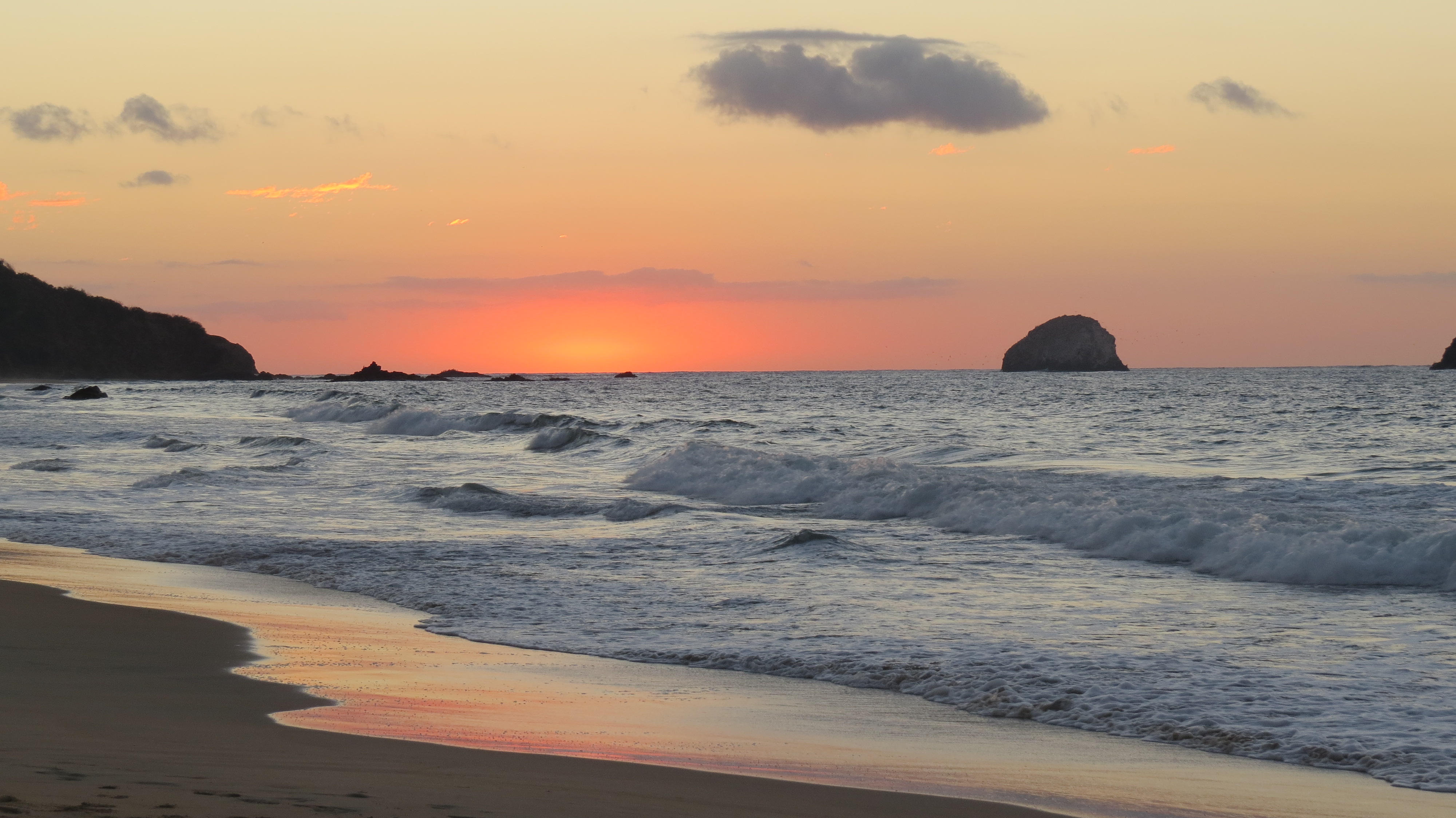
The setting sun low on the clear horizon painted the columns of Punta Hermanos, the Brothers, in hues of red, orange, and brown as we sailed past.  The southwesterly swell crashed against the columns but began to subside as we entered the large bay.

There are two beautiful anchorages in Tenacatita, each with a wide fringe of gold sand with rows of coconut palms beyond.  The first anchorage, called The Aquarium because of its turquoise reef abounding with fish, looked curiously empty.  We followed Adios around the outlying rocks of Punta Chubasco that made a tricky entrance into the second, larger anchorage filled with thirty one boats.

Then came a hail from Cat 2 Fold, a funky twin-masted catamaran.  “Do you know about the underwater rock?   If you divide the distance to the shore into thirds you can go in between the third third, which I often do.  Otherwise, go to starboard of the exposed rock.”

Adios coasted past the exposed rock, then made a sharp left-turn.  Cat 2 Fold drifted with the waning afternoon westerly, sails just barely drawing, as the young man at the tiller decided to move with what wind there was rather than turn on his engine.  He donned his guitar and sang into the early evening as he waited with infinite patience for his catamaran to creep slowly, slowly, at one-and-a-half knots toward the little village of La Manzanilla on the southern edge of the bay.

Adios, Adios; Pamela,” Pam hailed on VHF when we’d dropped our anchor a short while later.  “Hi guys!  Come on over for dinner.  We’ve got some red wine.”

“I’ve been reading about the land dispute,” said Craig when we settled into the cockpit with a lovely chicken and rice dish that Pam concocted.

“Land dispute?” I asked.  I didn’t have much information about the area.  Our cruising guide, about four years old, described the bay as a happy place where lots of locals come every Sunday to enjoy the sandy crescent of beach that bordered The Aquarium.

“Yes,” explained Craig.  “At the other anchorage near the point where you enter the bay, where we were at yesterday.  There’s a land development corporation that is claiming ownership of the area along the beach.  They say that squatters there have no right to the land, although some of the so-called squatters have been living there for 40 years.  They want to turn the beach into a big development.  They sent a notice that the people there must leave in 24 hours.  There were several hundred living there and operating restaurants and hotels, including a number of gringoes who have purchased property there.  Then the corporation came in with bulldozers and knocked down dozens of palapas along the beach.  There were violent demonstrations, and armed guards came in and shot up the crowd with rubber bullets, including children.”

It sounded like trouble in paradise.  Squatters?  Land dispute?  The cruising guide did not mention anything about rubber bullets.

“We anchored over there yesterday,” said Jane.  “It’s a lovely place.  We saw a whale with a calf as we entered the anchorage.  We landed the dinghy on the beach, and at six p.m. a couple of armed guards told us we had to leave the beach and go back to our boat.”

Armed guards?  This sounded like a place to avoid.  What a shame it would be to have to miss The Aquarium.

“What about the Jungle Tour?” asked Pam.  “How about if we go together tomorrow?”  The Jungle Tour is a narrow creek that runs through a mangrove swamp and connects the big anchorage with the smaller anchorage at The Aquarium.  You can take your dinghy up the creek for an adventure lasting several miles.

We made plans to meet Craig and Jane at 8:00 a.m. the following morning.

At 7:30 a.m. I shook Pam under her blanket in the V-berth.  “Wake up!  We need to get ready for the Jungle Tour.”  How early 7:30 a.m. seemed!  A year earlier I would awaken at 5:30 a.m. to do a few morning stretches and then walk Little Bear to the park, then make coffee and awaken Julian, then hustle him out the door to drive in darkness to catch his 7:05 a.m. train to San Francisco to his high school, then watch the sun come up as I drove the frozen convertible down Highway 280 to spend a half-hour in the gym before starting my work day by sifting through 150 emails searching for signs of relevance in the universe.

We set ourselves down gingerly into the dinghy as Jane brandished a large machete.  “I’m Jungle Jane!” she announced.  “Ready for the Jungle Tour.”

Jersey, her twelve-year-old puppy sat stoichly in the dinghy as the gentle morning swell pushed the boat up and down in a rhythmic pattern as we approached the creek that entered into the bay.  We followed behind Jeff and Janey on Adagio.  They had been up the Jungle Tour once before, so we trusted their “local knowledge” about the shoals at the mouth of the creek.  We entered the creek and navigated through a shallow section just deep enough to prevent the dinghy’s propeller from striking the bottom.  At the shallowest section I jumped over the side and pulled the dinghy through the cool dark morning waters, thinking about the point where the Napa River flows into the Amazon, where years before I had caught piranha.

The winding creek unfolded in a series of greens as the morning sun rose on the estuary.  Egrets took flight as we rove our dinghies through the myriad mangrove tunnels.  A giant iguana with a spiny yellow backbone perched on an ancient tree trunk ignored us as we powered our way up the flowing rivulet.

As the creek narrowed we gave thanks to the parties who had gone before us to slice back the tendrils of mangrove knees and arms that hung down from the canopy tops.  At regular intervals we encountered the sharpened edges of vines that had been hacked close to the water’s edge.

“Watch out for the sticks!” Craig warned, but too late, as Jersey met with a branch that grabbed her collar and hoisted her above the dinghy and over the side.  Jane grabbed her just in time, while a mosquito buzzed in my ear.

And just when we thought the jungle’s branches would prevent us from going any further, the creek widened and became a pond.  A broken down jetty greeted us at the far end.

“The crew from Scavenga came here recently,” said Craig.  “There’s a fence that was put up when the land dispute came to a head, blocking access to the beach.  They jumped the fence and made their way to the beach, when a security force with guns caught them.  The guards detained them, then demanded money, but the Scavenga crew told them they didn’t have any in their swim trunks.  So the guards demanded their wrist watches.”

Guards with guns demanding money?  I didn’t like the sound of this.

We landed the dinghies in the brackish water beside the splintering jetty.  Our cruising guide described this as a delightful place to tie the dinghy for a visit to the nearby beach.  That was before the land dispute.

“This is where they filmed the movie McHale’s Navy,” said Jeff.  I remembered the wacky late-60’s TV series and tried to imagine it as a feature film.  A team of Hollywood screenplay writers would have to be hard up to look to such a silly show for a movie plot.

We explored the mosquito-infested jetty to find a number of liquor bottles alongside an outdoor brick oven.  A hammock stretched between the oven and a pole supporting a deteriorating palapa roof.  Beyond the hammock were signs that read “Important!  Always wear your life jacket”, and a chain-link fence with two strands of barbed wire on top.

“This way!” announced Jeff.  “We can get around the fence over here.”

“Someone went to a lot of trouble to put up that fence,” I remarked.  “I don’t think we should tease these gun-toting fence builders.”

But around the fence we went, as a mosquito bit into my ankle.

Beyond the fence was the beach separated by a road that ran parallel to it.  As we made our way to the road a group of three men in military fatigues emerged from a concrete building.

“Hola!” shouted Jeff.  The men seemed perplexed.  By their wary movements it was clear they were not comfortable with us being there.  As they came forward the biggest one began shouting at us.  He looked mean, tall and stocky, and very capable in his jack boots.

“What happened?  What happened?” he shouted.  It didn’t make a lot of sense.  He was not carrying a gun but he did have a heavy night stick.  Busting the head of a peasant squatter, or a stupid gringo, might be good fun.

“We’re going to the beach,” we said.

“The sign!  What happened?”  The big man grabbed at his crotch and continued to yell at us.  He was not a real policeman, but was hired by someone to keep people out of the area past the beach, where we happened to be standing.  There were a few abandoned buildings along the road.  Someone didn’t want people squatting in these dilapidated buildings while the land dispute was being settled in the Mexican courts.

“We came up the creek on the Jungle Tour and we’re just going over to the beach.”

“What country you from?” asked crotch-grabber.  “What happened?  The sign!”  He motioned toward a sign that declared this area to be private property.  You would have to be facing the sign from the beach, not from the Jungle Tour, to notice the claim of private property.

It seemed pretty ridiculous.  I said “adios” and began walking back to the creek but crotch-grabber shouted “No!” and motioned for us to remain where we were, meanwhile yelling “What happened?” as if it made some semblance of sense.  Jane explained that we were from the U.S. and Canada, while crotch-grabber began an interrogation.

An older man, disheveled and unshaven, emerged from the concrete building and screwed his fists into his eyes.  He was apparently just waking up.  Crotch-grabber explained the situation to him in rapid Spanish.  A dialogue ensued to determine our fate.

The older man rubbing his eyes seemed to interject some reason into the conversation.  By his gestures and the occasionally understood Spanish word I sensed that if we would just turn around and head back to where we came from, they would call it a day and not shoot us.

“Let’s get out of here,” I said to Craig and began walking briskly back to the fence.

“Jeff!  Jane!  Come on,” he called, and as we walked in a group back toward the jetty it appeared that the three men in fatigues would not follow.  We made our way back around the chain link fence as dogs began to bark a short distance away.

“That was weird,” I said as we climbed back into our dinghies.  The abandoned jetty, the security fence, the guards — it all seemed irrational and I didn’t want to tempt any gun-toting security forces who might decide to detain us with meaningless questioning.

“I thought it was kind of fun,” said Jeff.  “Did you see the older guy?  I think he was packing a pistol.”

We drifted back down the creek and soon came upon an elder couple in a skiff.  They lived in the nearby village of Rebalsito and knew all about the land dispute.

They had been out fishing and the elder man in his mid-seventies lifted a 20-pound parvo, a big pink-red fish similar to a red snapper, from the stern of the skiff.  What a fish! we exclaimed.  Are they good to eat?  Wonderful, the man told us.

How early had he launched his skiff from the Jungle Tour creek to wind his way past the sand bar and out to the rocks at the edge of the bay?  “Very early,” he assured us.  I tried to imagine the mangrove-thick creek in the blackness of pre-dawn.

We told them about the security guards.  We were wise to turn back, they said.  The guards do not have a right to prevent access to the beach, but they can intimidate you into thinking that they do.  They are paid by the land development company to keep people off the disputed land.  The man and woman were covered in muddy pants and shirts with wide-brimmed hats that hung down over their ears.  They were familiar with the intense morning sun.

They had come here about 30 years before and made Rebalsito their home during the winter.  When the land dispute boiled over in 2010 they began a relief effort to help the many families who lived on the beach and operated the palapa restaurants for the teeming crowds of locals who converged on the beach every weekend.  They established a fund called The Tenacatita Fund and raised $30,000 to help the displaced families.

“They are very resilient,” said the woman.  “When they were kicked off the beach some of them went to La Manzanilla.  They found what work they could.”  With the funds they raised they were able to provide food for many of these families for a month while they struggled to find new homes and jobs.

The Rodenas Corporation has been trying to get people off the Tenacatita beach for two decades and has been battling with the local ejido, or land cooperative. Ejidos were set up by the Mexican government to implement the land reforms fought for in the Mexican revolution of 1910, and the ejido that includes Tenacatita beach was established in 1940.

On the morning of August 4, 2010, Rodenas sent in the state police in riot gear based on a judicial order.  No one has actually seen the order.  The police demanded that the residents leave immediately, forcibly removing them.  Nearly 800 Mexican citizens were routed from their homes by 200 police and forced to leave at gunpoint.  Several shots were fired into the air to scare the residents, and many unarmed residents were injured, their possessions seized, their stores looted, the contents of their restaurant kitchens emptied into the street.  The road to the beach was blocked by a gate and controlled by a Rodenas security force.

Three years later, in June 2013 the gate and guard post were torn down, again by a court order and by state police.  But while the beach is now open, no one is allowed to camp or stay overnight and no one is allowed to operate a restaurant.  Meanwhile, the land dispute continues to meander through the Mexican court system like the Jungle Tour through the mangrove swamp.

The day after our Jungle Tour adventure we paddled our kayak to the beach to play bocci ball.  The highlight of each day in Tenacatita is the 2:00 p.m. bocci ball game on the beach, played by the cruisers who often spend several weeks, sometimes months, anchored in the bay.  I went for a run up the beach to enjoy the warm sand and cool sea breeze.  At the end of the beach where all the boats are anchored there is only a single palapa restaurant tucked into the coconut palms next to the Jungle Tour creek.  The beach is beautifully undeveloped for about a half a mile.  Then you come to a bright orange mega-hotel built into a natural rock formation.

As I approached the rock I heard something like a police whistle.  I continued running past the hotel, wondering how I could get to the empty beach beyond the rock.  The whistle continued.  I began to get irritated.  Was someone trying to signal me to stop and not proceed past the hotel?

A man in a white uniform with a serious face appeared on the beach beside the rock formation.  He was gesturing emphatically for me to turn around and go the other way.  I stopped running and stood and looked at him.  He continued to wave his arms and point to the other end of the beach.

I couldn’t believe it.  The Rodenas security guards kicked me off the beach by The Aquarium, and now this hotel security guy was kicking me off the other beach.  What was up with Tenacatita?  Could I stay there only if I agreed to stay in one place, keep quiet, and play bocci ball?

I realized that the hotel guard was just an ordinary man doing his unpleasant job, and I decided to comply, even though beaches in Mexico are not private property.  I didn’t want to yell at him like a stupid gringo tourist about my right to walk on the beach.

“OK,” I said as I approached him with a friendly smile.  “Me llamo Dennis,” I told him as I offered him my hand.  He shook it with a quizzical expression.  “Que bonita dia, si?

Si,” he answered, it was a beautiful day.  He looked uncertain.

Adios!” I said, then turned and ran back to the safety of the bocci ball game.

We stayed in the big anchorage a few more days scraping barnacles off the bottom of the boat and slowly passing the time in between the bocci ball games.  But I wanted to go back and see The Aquarium and snorkel in the clear water around the rocky reefs.  So we pulled up the anchor and sailed a couple of miles over to The Aquarium beach.  I scoured the beach with my binoculars as we approached, watching for signs of the security guards and noticing the abandoned buildings with missing windows and doors.

I picked a spot to anchor near the beach, then suddenly saw a pair of whale spouts in between me and the anchoring spot.  A small black fin appeared and then disappeared, followed by a much larger fin and a long dark shape.  It was the mother and calf!

The whales swam silently past the anchorage, reversed course to make another pass, then turned again.  They didn’t seem to be any kind of hurry. Meanwhile, I sailed Pamela in circles to wait for the whales to move away from my path to the beach.

We set the anchor and then paddled the kayak to the shore.  A small boy played in the water while his smiling parents rested in a shady spot next to an abandoned building.  A few families laughed and called to one another further down the beach.  It was good to see people enjoying the beach, but nothing like the photos from our cruising guide that showed scores of families playing on the sunny beach.  The abandoned buildings produced a feeling of apocalypse.  There was no sign of the security guards.

I imagined the beach full of of colorful palapas and kids splashing in the water and old people sitting fully dressed in the soft surf, the beach alive with activity and sounds.  I imagined getting some rollo de mar, a local favorite, a fresh fish filet around an octopus wrapped with a slice of bacon and covered in an almond cream sauce.  It might be years before the local palapas are allowed to return to the beach, if they can get some of their land back, and if Rodenas’ luxury hotel on 100 acres does not crowd them out.

We enjoyed the reef, especially seeing several striped eels and hundreds of colorful fish, but we did not stay long.  We hoisted the sails and let the west wind carry us back to the anchorage with the other boats and the security of afternoon bocci ball.

We attended the “Mayor’s Raft-Up” off Good Dog Beach.  The “mayor” is the cruiser who’s been in Tenacatita the longest, and this honor goes to Robert and Virginia from Harmony who have been coming to Tenacatita each winter for a dozen years.  On Friday night the cruisers tie up their dinghies in a circle and Robert asks them a special question.  On this particular occasion there was Scott and Connie from Traveler, so Robert announced that the raft-up would include a talent show.  Connie, a professional singer, played the ukelele while the crew from Traveler sang a tune that Connie had composed, followed by “Mama Don’t Allow No Ukelele Playin’ ‘Round Here”.  We made plans for a jam session on Pamela the following night, then followed Robert and Virginia back to Harmony to purchase some colorful tie-dyed T-shirts they’d made and to get a signed copy of Virginia’s book, Harmony On The High Seas: When Your Mate Becomes Your Matey.

You meet some very interesting people out cruising.  It seems everyone has written a book.  Virginia’s book tells how she and Robert joined The Caravan in 1970, with 250 traveling hippies on 60 buses and vans on a four-month odyssey to rediscover America.  In Tennessee they helped start up The Farm, one of the largest communes of that era.  They put six kids through college at the University of California, then began their cruising career with several tours of Mexico, and eventually Central America and Ecuador.

We visited the nearby town of La Manzanilla with its interesting cocodrillo, a crocodile sanctuary.  You don’t have to ask where to find it, you just walk to the edge of town where the road ends, and there you see a large prehistoric crocodile sleeping with his toothy snout in the sun and his wide tail in the muddy estuary.  You can see why these creatures have endured for millions of years — they can lie absolutely motionless for days, paying no attention to the flies landing on their eyelids or the tourists snapping photos.  After La Manzanilla we sailed back to the quiet Tenacatita anchorage and practiced being crocodiles for a few more days.

We left the wide bay after a week and splashed through a churning seaway with 30-knot winds to Bahia Navidad, a dozen miles to the south.  We toured the towns of Melaque and Barra de Navidad and splurged by tying up at Marina de Puerto Navidad with its spectacular luxury hotel complex surrounded by blue swimming pools and green mountains.  In the pool we met several cruisers who had spent two or three weeks there, enjoying the pool and the restaurants of Barra, who would go no further than Mexico, and couldn’t see why we wanted to sailed away to Polynesia.

A few days later we were back in Tenacatita attending the Mayor’s Raft-Up off Good Dog Beach.  I brought my guitar and sang a song I’d just composed about being a lazy boy on a lazy day.

Lazy days and nights and all of the minutes in between

I don’t believe in the concept of time, I don’t know what it means

I was the only man there singing cheerfully about being a no-good lazy bum.  As the other cruisers introduced themselves, each of the men professed to have no talent but were good at fixing things, while their wives  bragged about how the men had kept their boats in good shape, fixing engines and rebuilding galleys.  I was the only man there who hadn’t rebuilt his transmission in the past 30 days.  I hung my head and tried to wipe the silly crocodile grin off my shameful face.

I needed to give something back.  It wasn’t enough to float day after day, scraping off a barnacle now and then, chucking a bocci ball, acting like a crocodile.  I needed to contribute something.  I picked up the VHF and announced “Attention the fleet!  Attention the fleet!  At 5:00 p.m. Pamela will offer a free guitar lesson.  Bring your instrument.”  A sense of euphoric accomplishment rushed through my veins and buzzed in my ears.

That evening, two dinghies motored up to Pamela with guitars!  I’m not sure what should happen in a guitar lesson since I’ve never really had one, so I winged it.  “Here’s how you hold a pick,” I demonstrated.  “You hold it like this, and you make a major chord like this.”  My students were riveted.  “And you can compose a song like this:  just go from the tonic to the fifth, the minor sixth, and add a cadence on the fourth, see?”  The eager expressions sagged in a barely perceptible hint of uncertainty.

I soldiered on.  “And you can offer a tint of dissonance with a minor third flat five chord that resolves into a minor seven … see?  Boy, I wish someone had showed me all this when I was getting started on guitar!”

Glazed eyes blinked.  I waited for my students to fret the neo-classical jazz chords but there was an unspoken reluctance.  “How about some more wine?” I offered, and the lesson was saved.

Soon it was time to head back up north to Banderas Bay and leave Tenacatita behind.  The barnacles that I was unable to scrape off in Bahia Tenacatita would have to ride on Pamela’s bottom all the way back up to La Cruz.  The more tenacious barnacles would get a free ride across the South Pacific to Hiva Oa in an epic westward migration.  The bocci ball would have to go on without us, and the court battles to defend David against the Rodenas Goliath.

The sun was rising over Bahia Tenacatita as we raised Pamela’s anchor and sailed silently out of the anchorage, past the outlying rocks of Punta Chubasco, past the turquoise reefs surrounding The Anchorage and the desecrated buildings of Tenacatita Beach that had been forcibly abandoned but not bulldozed.

Suddenly there was a splash of white water just off Tenacatita Beach.  I focused my attention on the spot and waited.  A dorsal fin appeared, and then a breaching whale.  It was the mother and calf.  While the mother streamed along in modest propriety, her calf launched high above the surface of the bay and allowed the morning sun to paint a swath of red across its white belly, landing with a pink splash on the tranquil bay.

Over and over the juvenile calf leaped for joy as Pamela bid her adios.

La Cruise

There’s a poet in me.  He loves romantic beginnings.  He wants to know the history of every place he visits.  He wants to invent a history of La Cruz de Huanacaxtle, the fishing village on the northwest shore of Banderas Bay on the Mexican Pacific.

In my invention, the village has been there for 700 years.  The Huichol are there tending their nets on the beach while their women hack away in their small fields of mais along the arroyo before the green mountains begin their ascent.  A young man rests in the heat of the day beneath the ageless huanacaxtle trees in the center of the village.  Daydreaming about wrestling matches with the other boys in the village, he is restless.  He is small for his age, so in his reveries he imagines he is bigger and stronger.  The largest boy in the village bullies him at will, but not today.  In this daydream he leaps deftly to one side as the bully rushes him, tripping the bigger boy and pinning him to the ground.

There is talk in the village of Cortez.  He marches with 100 men in protective skins of sky iron.  They ride on mythical long-haired beasts with four legs like dogs but much greater.  They take what they desire.

Beneath the huanacaxtle tree there is a stirring of leaves and a dog barks madly.  It is Cortez.  The boy does not have time to think.  He hefts his fishing pike as the Spaniard jumps from the great dog beast and pulls a sword from a scabbard studded with gold sequins.  The boy leaps to one side, tripping the man, then runs his pike through his chest and pins him to the huanacaxtle tree.  The arms of the dead man are spread in a cross like Da Vinci’s Vitruvian Man, and forever the village is known as The Cross of the Huanacaxtle.

But it didn’t happen like that.  The history of La Cruz is much more recent.  It became a fishing village in the 1930’s. Only a couple of decades before sleepy Puerto Vallarta was discovered by Richard Burton and Ava Gardner in The Nght of the Iguana.  In those years there was a large cross under a big huanacaxtle tree near the waterfront.  Simply a cross, with no obvious purpose, and that became the name for the town.

The first thing we saw as we sailed into the La Cruz anchorage were two humpback whales, actually swimming through the anchorage.  In thirty-five feet of water and in between the anchored sailboats, these gentle creatures showed first their dorsal fins and then their silent flukes as they sounded beneath the surface.  We never saw them come back up.

We launched the kayak in the smooth anchorage to paddle into town.  “Hey, Pamela!”  we heard as we passed Adios, a boat we knew from La Paz.  “Are you racing in the Banderas Blast?  We need crew.”  And so we were recruited as hired guns to race with Craig and Jane the following couple of days.  When you’re out cruising, you never really know what you’re going to do tomorrow or the following day.  The days have a way of unfolding themselves.

We tied up the kayak in the marina and followed the walkway into town.  The first thing we saw as we walked into the village was the huge huanacaxtle trees in the square by the waterfront.  There was a local music festival going on and all the town was sitting under the ancient trees.

In the town we ran into Larry who we’d also met in La Paz.  Larry, Joe, and I had jammed on Rapscullion with Pamela Bendall who had just published her book, What Was I Thinking?, recounting her adventures as a solo sailor down the coast of North, Central, and South America.

“I’m going to introduce you to the musicians in town,” Larry announced.  “This is Russ.  He plays harmonica.  And this is Stevie the bass player, and Bobbie plays acoustic blues guitar, and Chuck over there plays electric guitar.“

Larry told me all about the La Cruz music scene.  “There’s a blues jam at Philo’s on Monday night, another jam at the British Club on Tuesdays, good Flamenco on Friday at the Black Forest, and always something going on at Octopus’ Garden.  Hey!  Hear that?  That sounds like a rock band at Ana Bananas.  Wanna check it out?”

“What?  Down that dark street there?  Is it okay to walk down there at night?”

“Certainly,” said Larry and off we paced along the dark cobblestoned path of a street that revealed a lavanderia and a tortilleria by day.

During the following day’s race on Banderas Bay we came in second place and met Dick who’s lived in La Cruz for a number of years.  He was in his seventies, had run a bed & breakfast in the nearby surfing town of Sayulita, and now was retired and living just up the street from the tortilleria.  He gave us instructions for using the local bus system.  We needed to figure out how to get to the airport to pick up our boys who were to spend their college break with us.

“Now, to get back to La Cruz from the airport you have to walk across the bridge over the highway,” Dick advised.  “The taxis at the airport have to pay a tax, so it’s lots cheaper taking a taxi or a bus on the other side of the highway.  Now, there’s a marlin taco shop on the other side of the bridge near where you catch the bus.  Best tacos anywhere, with real smoked marlin.  Now, they don’t sell beer at the marlin taco shop so you have to go down just past the bus stop to get a couple bottles of beer at the little tienda.  Coldest beers anywhere.  Now, you get your bottles of beer at the tienda then take them back to the marlin taco shop, and they have a deposito at the marlin taco shop so they pick up the empty bottles there.”

“Uh … OK.”  Why was Dick telling me all these details about a taco stand?  What could I possibly do with all this mundane information and how could I possibly remember it?

It turned out that in the next four weeks we made six different trips to the airport to pick up and drop off the boys and flying to and from Oaxaca.  We followed Dick’s detailed instructions to the letter and got marlin tacos and cold beer with every airport run.  I found myself repeating Dick’s instructions later to various cruising friends who were coming in and out of the airport for the holidays, each time watching their expressions as I repeated the details.

When the boys arrived we sailed to Nueva Vallarta and Paradise Village.  It was as if we were magically back in the USA.  There was a Starbucks coffee shop by the bus stop, a Subway sandwich shop by the mall, and plenty of prosperous gringos beside the pool or arranged in neat rows along the beach.

“You guys are not Paradise Village people,” one of the cruisers in the Baja Ha-Ha had told us.  “Go to La Cruz.  La Cruz is real.”  What could he mean by that?

We spent Christmas Eve at Punta de Mita at the head of Banderas Bay, then Christmas Day at Islas Tres Marietas, a marine sanctuary, climbing on rocks and snorkeling along the reefs.  In the late 1960’s, Jacques Cousteau  led an international outcry to prevent the Mexican government from bombing these uninhabited islands.

Pam and the boys gave me a GoPro video recorder for Christmas.  The boys threw handfuls of pretzels over the side of the boat and made underwater movies of hundreds of pretzel-eating fish.  They were jumping off the sides of the boat and filming underwater explosions when Joe arrived on Cygnus.

“I’ll just swim over and say hello,” he said as he dove into the blue water and swam up to Pamela’s swim ladder.

“Watch out for the explosions,” I warned.

We sat on the deck in the late afternoon sun as the boys made their movies and Joe told us more about the La Cruz music scene.  That evening we sailed back to La Cruz.  Pushed by light westerly winds we glided past humpback whales, then anchored at La Cruz listening to dolphins splashing beside the boat and exhaling loudly in the calm waters.

For New Year’s we wandered the streets of La Cruz in the rain looking for entertainment for the boys.  At Octopus’ Garden we had dinner with Robin and Mark from Mintaka, who we promised to sail to Polynesia with.  Just before midnight our waiter brought us each a dozen grapes.  He beamed as he set the bowls of grapes in front of us.

“You take these grapes,” Robin explained, “and you put the first one in your mouth twelve minutes before New Year’s.  Each minute you put another grape in your mouth.”

“You do what?” I asked.

“Yhuh hmput fmuggen” explained Pam with five grapes in her mouth.  “It’s a Mexican tradition.  At midnight with all twelve grapes in your mouth you make a wish, then you swallow the grapes.”  At about six minutes to midnight my mouth was so full of grapes that my eyes bulged as I tried to breath and make more wishes.

Ten days later, after touring the Oaxacan countryside in the pursuit of mole negra and artesian tapestries, the extensive ruins of ancient Monte Alban,  and the seaside villages of Puerto Escondido and San Augustillo, we found ourselves once again in La Cruz.  The town was starting to grow on me.

“¿Pamela, si?” confirmed the señorita at the lavanderia who washed the Oaxacan dust out of our clothes.  After taking our laundry once before to this corner laundromat the young lady remembered the name of our boat.  I was beginning to feel at home in La Cruz.

So what is it about La Cruz that is so appealing?  It’s not a romantic fishing village.  Rather, its tiny network of streets are dusty in the heat of the day and muddy after a rain.  Many are cobblestoned, but with potholes and mud puddles.  The buildings are somewhat dilapidated and run-down.

I think its a combination of many small things that keeps bringing us back to La Cruz.  A wonderful market of organic greens on Sunday morning.  A fabulous fish market filled with dorado, tuna, and shrimp.  A funky shack by the main road selling grilled chicken on skewers over a fire.

And a brand new marina with lots of space, water, fuel, and wi-fi.  Plus, a good anchorage, seldom rolly, and capable of sheltering dozens of boats.

Not least, its where we continue to meet all our cruising friends as they make their way down from Cabo, the Sea of Cortez, and Mazatlán.  Everyone stops in La Cruz for a while, and the evenings we’ve spent having dinners and drinks on our boats, or listening to blues bands playing the funky bars in town, or simply enjoying tacos in the streets of La Cruz, have all been magical.

But what is the final thing about La Cruz de Huanacaxtle, that elusive ingredient that other towns do not have?  Its the old huanacaxtle trees.  Their trunks are easily ten feet in diameter.  Their canopy tops provide shade for the entire village square.  The curve of their expansive branches is as graceful as the arc of a gothic cathedral’s flying buttresses.

In the coming years La Cruz will “grow up”.  The ever-expanding pace of development that spawned from The Night of the Iguana will eventually make its way around the entire Bahia de Banderas and condominiums will one day consume La Cruz.  The laws of supply and demand, the growing middle class of Mexico, and sun-hungry Norte Americanos will conspire to turn the friendly fishing village into a bustling urban center like Puerto Vallarta.

But the huanacaxtle trees in the village square are destined to remain forever protected because the name of the town makes it so.  The cross is gone, but the trees remain.  And while the town named after these trees may not have a romantic past, the huanacaxtle trees will inspire its romantic future.

Old Mazatlán

Music blasting from all quarters is a common treat in many of the Mexican towns we’ve visited on sailing vessel Pamela.  It’s sometimes used as a way to attract shoppers into a store, with huge black speakers placed on the walkway in front of the store thumping loud enough to crumple the concrete sidewalk.  I pass by these storefronts walking fast as I can with fingers stuffed into both ears, wondering if this is karma payback for the times when I played seared-ahi electric guitar solos so loud that the band’s bass player had to hide behind his amp stack.

Mazatlán is no different, particularly the large mercado area where the local bus drops you off on your way into town.  Here the hundreds of vendors compete to attract shoppers for sunglasses, T-shirts, chicken feet, pig heads, you name it.  In the din of a swelling cacophonous rancor they tempt you with “HOLA AMIGO!” and wide smiles as they gesture grandly toward their rack of T-shirts.

But walking two blocks out of the mercado area you enter Old Mazatlán.  You notice the colonial buildings and the small tree-lined streets.  You see fewer people walking these streets, especially compared to the busy mercado a couple of blocks away.  But most of all you realize that you can hear again.

And what an aural feast as you make your way further into the old town!  There is classical piano coming from around the corner.  Then a jazz trumpeter, very good, playing mixolydian and phrygian scales.  Down another street you hear an operatic soprano.  Where do they get these records from, you wonder aloud.

And then you begin to realize what is actually happening:  classically trained music students, cloistered in their studios, are practicing their art in the heat of the day.  These are real people playing real instruments, and playing them very well.

The blaring speakers in the shops of the mercado seem like another dimension in time and space.  Another universe altogether.  An assault on the senses that must be endured like a kind of gauntlet before the traveller is allowed to experience the Eden of the classical old town.

On another level, the art studios of Old Mazatlán beckon.  There are two dozen or more that participate each month in a Friday Art Walk.  Some of them are galleries showing beautiful renderings from the area’s many painters and sculptors.  Some are the studios of the artists themselves, where you can admire the work as you meet the actual hands that produced it.  These artists seem like real, everyday people, you whisper to yourself.  Common people like you and me, yet with the indomitable determination to practice their passion day after day.

Some of the galleries are restaurants and bars.  We wandered into one called Delirium on Calle Sixto Osuna, with a half dozen rooms to stroll through to view paintings or sit to have dinner.  In a room that opened out to the street sat a young man working on a laptop while an iPad wired to the house speaker system played a documentary about Mexican artists.

The music from the documentary was tasteful and interesting.  The images from the video drew my attention further and soon I was absorbed.  There were young men with acoustic guitars, groups of singers in a cappela choruses, an elder rocker singing passionately into a microphone as he stabbed at his electric guitar.  I was transfixed.  Any kind of documentary about real musicians telling their true story always draws my full attention.  The feeling from my gut is visceral.  It inspires me.  It tells me to go pick up my guitar and express something true.

Muy interessante,” I said to the young man in the corner.

“Yes, it is,” he replied.

Pam arrived from the adjacent room with two glasses of red wine.  “You should see this painting over here,” she beckoned.  “Look at these colors!”

A young woman with Italianate features chatted with us as we strolled through the adjoining room.  The young man in the corner, smiling and speaking educated English very rich in vocabulary, told us more about the studio.  He introduced himself as Juan Pablo, and told us he had recently built Delirium with the young woman, who introduced herself as Ana Paola Osuna Corona.  Juan Pablo Sanchez King y Ana Paola Osuna Corona y Delirium a Sixto Osuna.  The poetic syllables and the red wine made my head swim.

We sat in the room that opened out to the street and sipped our wine as we told our respective stories.  Juan Pablo and Ana Paola were taking a break from an online media career and starting an artistic venture in Old Mazatlán, while we were taking a break from Silicon Valley and sailing our boat across the South Pacific.  We ordered more wine and continued the conversation, captivated by their enthusiasm and love of life.

“Will you have dinner?” asked Juan Pablo.

“Certainly,” we replied.  We had planned to visit a well-regarded restaurant called Topolo a few blocks away, but that could wait until tomorrow.  “What do you have?”

“Tacos,” announced Juan Pablo.

I waited for Pam to blanche, which she did a half a moment later.

I’m okay with tacos.  They’re simple and soulful.  I could eat them everyday  and then have my tomb stuffed with them to lead me triumphantly into the afterlife.  Not so with Pam.  Having lived in the French quarter of Switzerland, she’s been spoiled by sauce bearnaise and Gruyère cheese.  You will never find either of these on a taco.  You can live longer than Methusula’s 969 years, and tack on 31 more to complete the epoch, and still you will not find Gruyère cheese on a taco in Mexico.

Ana Paola brought the tacos to our table.  There were wonderful.  They had exotic names.  The one called Zen had shrimp, local chiles, and Gruyère cheese.

“Gruyère cheese!” I exclaimed.  Juan Pablo grinned.

The Angelópolis featured portobello mushroom and mole poblano artesanal, foreshadowing the delights we would experience later in Oaxaca.  The Vegano included pesto.  The Sorpresa was mysteriously presented with no explanation at all (“no te diremos que tiene sólo que está delicioso”).

We walked out into the warm evening feeling satisfied and satiated, then caught a pulmonia, a three-wheeled motor-cart, back to Marina Mazatlán at the far edge of town.

A few days later we were back in Old Mazatlán.  There were still a few galleries that Pam needed to track down.  Besides, we had discovered a cafe with wonderful cappuccino, which justified the rollicking pulmonia ride into town.  I turned a corner to hear a piano recital hidden within monastic walls, then gazed into the window of a gallery restaurant to see Juan Pablo beaming at me.

“Hello!” he grinned.  “Come meet my friend from Germany!  We’re working on a project.”

Juan Pablo’s friend from Germany was a professional photographer.  He showed us a photo of a brown paper bag placed flat on a table with something scrawled on it.  I squinted at the image.

“What do you think it is?” asked Juan Pablo.  His friend from Germany began videotaping our reaction.

“Well … it looks like a Tree of Life,” I ventured.  “There is a canopy here, with ants climbing up the trunk.”

The videocamera flashed a red dot every half-second.  This was real-life being captured real-time.  I couldn’t respond with a silly obscure quip.  I had to think about it.

“There is another Tree here,” I motioned to the other side of the drawing.  “This one seems to be the mirror image of the other, or maybe the roots.  One is moving up to the heavens while the other is grounding itself with the Earth.”  I was on a roll.  “The ants here are moving up the tree in groups of two, while the ants in the Tree above are moving in triplets.”  I waited for a knowing nod from Juan Pablo.  He stared at me while his friend from Germany recorded everything.

“What do you see, Pamela?”

Pam’s view was more anthroposophical.  “There is a balance here represented by the separate sides of the tree.  And yet there is also the symbol of an onion, suggesting the idea of multiple layers.  Layers often represent the many levels of consciousness.”  Juan Pablo was spellbound.

“So … what is it?” I asked him.

“My friend and I are starting a new project,” he explained.  “We sat down at a table with this piece of paper and began drawing, each on our own half without looking at what the other was doing.  After a few minutes we turned the sheet of paper around and started marking on the drawing of the other.”

“You didn’t know what each was drawing?” I asked.

“Not until we turned the sheet.”

“And the ants moving into self-actualization?” I queried.

“Ants?” responded Juan Pablo.  There went my theory of triplets.

“So what does it mean?” I persisted.

“Not sure.  But we thought that before we start this project we should collect our ideas in abstract form and then superimpose one upon the other into a formulaic blend.”  Meanwhile the friend from Germany, a true professional, faithfully captured the entire encounter without blinking.

I felt encapsulated in art in motion.  At the vortex of fact and fancy, enterprise and indulgence, forward thinking and quiet mind.

We waved goodbye to Juan Pablo and his friend from Germany, then ventured further down the colonial street to find the elusive cappuccino.

A couple of weeks later an email arrived from Juan Pablo and Ana Paola.  When our voyage is done will we come back to Old Mazatlán to present our experience in the Delirium gallery?  “You can show your photos, and parts from your boat,” Juan Pablo encouraged us.  I imagined a multimedia presentation with acoustic guitar followed by a reading of my prose, illustrated by Pam’s watercolors, and with a worn impeller and corroded sacrificial zincs nailed to a board on the wall.

I rubbed my chin and thought hard about this idea and began to warm to it.  Our worldwide debut, our sailing adventure expressed as a multimedia art exhibit in Old Mazatlán, with the colonial streets alive with strains of chamber music and modern jazz echoing from hidden courtyards.

Such inventiveness!  Juan Pablo’s creative mind innovating new experiences with the freshness and tang of poblano.

But who would come all the way to Mazatlán to see the exhibit?

Everyone!  And Juan Pablo Sanchez King and Ana Paola Osuna Corona.

It will be the art event of the decade that you will surely not want to miss.

La Paused

At 11:00 a.m. the sun was starting to get hot and the shade of the Dockside cafe looked pretty good.  A cold drink was in order.  I heard English spoken in the corner at a table overlooking the little harbor.

The two men were indistinguishable from each other, both in their mid-sixties, portly and bearded, with gray pony tails, khaki cargo shorts, and Hawaiian shirts.  The woman sitting with them was similar, minus the beard.

“I’m gonna have me one more beer then go have my afternoon nap,” announced one of the men.  “That’s what I’m gonna do today.”  His face brightened into a broad grin about the day’s plan.

“I’ll do the same,” said the other man.

They laughed heartily for a moment, then paused as a dinghy with a small noisy outboard motor put-putted out of the harbor.

“Two stroke,” said the woman.

They say there’s tar at the bottom of the anchorage in La Paz, Mexico, and if you try to raise your anchor the tar holds you fast.  The bottom is actually sand, good holding, with a tidal current that swings your boat in a circle twice each day.  There are lots of boats in the free anchorage, and they swing independently through the current in a movement called “the La Paz waltz.”

There are beautiful old-style yawls and sleek modern Beneteaus sharing the anchorage with derelict dismasted boats that have turned into barnacle-encrusted havens for pelicans.  The pelicans are quiet and stately, albeit numerous, and deserve a peaceful place to rest, so the derelict boats serve as an ornithological sanctuary.  Or an eyesore.  The anchorage is well protected in a long estuary.  It’s a convenient place to set your anchor for a while, maybe years, making the easy trip to the dinghy dock the primary event of the morning.

The primary event of the evening, of course, is bringing in the dinghy for a trip to Rancho Viejo for arachera, a high grade of carne asada, tucked into a taco de mais and smothered with chili peppers, accompanied by an ice-cold Negra Modela.

It was time for a pause.  We had sailed nearly 1000 miles down the Baja peninsula, around the cape, and up into the Sea of Cortez.  We  had endured four days tied up to a pier in Cabo San Lucus, where, because of my shaggy hair and scraggly beard I’d been offered every kind of illicit drug by the various street merchants pretending to sell Cuban cigars.

“Hola, amigo.  Pssst … I got it!”

“Got what?”

I got it.”  Wink wink.  He deftly turned the cigar box over to reveal what was hidden on the other side.  He definitely had it.

“Pam, he’s got it.”

“What?  Got what?”

“Should we get some?”

“What are you talking about?”

Pam was oblivious to the street offers happening with regular frequency on either side as we strolled along the wharf.

We sailed into La Paz with about fifteen other boats that we recognized from the Baja Ha-Ha.  Mintaka, Maluhia, Celebration, Betty Jane, Tillie, Cygnus, Ariel 4, some in the marina, some anchored out.

“What are your plans?” I asked everyone.

“No plans at the moment,” was a common reply.

“We’re going to sail out to Espiritu Santo and Isla Partida, probably anchor in Caleta de Partida to tuck in against the swell from the southwest, then tack up to San Francisco, San Jose, hopefully as far as Agua Verde before we have to turn around.”

“Oh.”

Maybe I was over-thinking it.  Everyone was ready for a good long pause but I was still making travel plans.

Our few days in La Paz were not much of a pause.  I was still in “get it done” mode.  I had the propane topped up and the zinc replaced on the end of the propeller.  We spent a half a day at the TelCel store to get our Banda Ancha 3G device to plug into the Mac — this would provide internet while in proximity of any town with a cell tower.  We roamed the streets for fresh produce and discovered the side street where the local organic farmers sell fresh lettuce, basil, and cilantro.  Our efforts to find a good cappuccino had paid off.  Now it was time to move on and see the Sea of Cortez.

We rode a southerly up to San Evaristo, a tiny fishing village about 60 miles north of La Paz on a crescent of sand surrounded by tall mountains.  Then the grand tour was interrupted by a northerly blowing gusts up to 30 knots down the Sea.  Back in San Francisco Bay, a day sail with 30 knots is somewhat common.  But going north up the Sea banging into waves and wind that high is a big deal, and the advice from sonrisanet, a Ham radio frequency with regular forecasts for the Sea of Cortez, was to find a protected anchorage to sit out the three-day blow.

We met Walter on the beach at San Evaristo and he helped us buy a fish.

“La pescadero es se vender?” I queried a fisherman who was cutting up a fish under a palm frond shelter.  My Spanish is bad and getting worse.  I was asking the fisherman whether he was putting himself up for sale.

Walter intervened, explaining that these fish belonged to someone else and the fish-cleaning crew were actually hired to clean the fish.  The fish were to be taken to La Paz and sold.

“They brought in a nice halibut this afternoon.  I would hold out for the halibut,” Walter advised.  He was the spitting image of an elderly David Crosby (of Crosby, Stills, and Nash) with a Crosby-esque mischievous twinkle in his eye.  He was from Santa Barbara but and had been coming down to Baja and San Evaristo for the past 50 years.  The fisherman on the beach knew him well.

He led us a short way down the beach to speak with a man sitting in the shade of a small concrete-block building.  He seemed to be haggling with the man about the halibut.

“I think you could get it for 50 pesos,” he coached.  About four dollars, a good price for a fresh-caught fish.  “I want to get a little piece of it for sashimi.”  The man took the halibut out of an ice chest in the back of a pickup truck and showed it to us.  It was a nice five-pound fish.  Best of it, it was a white fish, not like the oily blood-red skip jacks I had been catching on my hand line.

Pam pulled out a 200-peso note to pay the man but he frowned.  Walter explained that the man could not break the 200-peso note.  Then Walter made a deal with Pam for his sashimi.  “Look,” he said.  “You give me your 200-peso note and I’ll give you back two 100-peso bills plus a 10-peso coin.”  The haggling in Spanish and the mathematics seemed to confuse us.  Were we getting ripped off somehow?  This was turning into a minor adventure, and I decided to run with it.

“Will they clean and filet the fish for us?” I asked.  Walter translated this to the man and the man pointed at two other fisherman standing about.  One of the fishermen had a hard unfriendly look, a lean muscular build, and a brand new pair of yellow rubber boots.  He took out his filet knife and began working on the fish, deftly cutting along the spine and removing the bones, using a garbage can lid as a table.  Pam blanched as he tossed the filets on the unclean surface.  I noticed that he placed them skin-side down, keeping the meat clean.  He delicately cut between the skin and the flesh, then handed me each clean filet to place into a plastic bag.  His hard look dissolved as I handed him a 20-peso note and respectfully thanked him for his work.

Walter got a small piece for his sashimi.  I wasn’t satisfied with this.  After all, he had advised us as to where and how to get the best fish, he had secured for us a nice deal, and had provided translation services.  I asked señor yellow-boots to cut one of the filets in half, then gave it to Walter as a tip.  He smiled broadly, and now we were all smiling.  Walter took his sashimi back to his camper, a small pickup with a shell and a hard-bottom dinghy on top.  He was definitely taking a pause.

I wondered what I would do for four days in San Evaristo.  We prepared the halibut, kayaked around the small bay, snorkeled on the rocks by the point, and simply watched the days go by.  As the sun rose each morning, the jagged mountains to the west turned red.  The clarity of the morning light showed every crevice, ridge, and valley of that rugged range.  The wind grew stronger as the days passed and the boat sailed around on its anchor, but we were secure and happy.

A few days later we were back in La Paz.  We anchored next to one of our new friends, then met all of the others as we paddled the kayak to the dinghy dock in the marina.  How magical to see our friends again!  We had sundowners and dinner on Celebration, ran a 6K fun run with Ariel 4 and saw a movie about their Northwest Passage (yes, they sailed from Sweden over the top of North America to join the Baja Ha-Ha fleet in San Diego), went out for arachera with Mintaka and Maluhia, had a guitar jam with Cynus, chatted with Betty Jane in the market, and delivered a gift of fresh bagels to Tillie.  We made new friends as we joined a guitar jam on Rapscullion.  We entertained our friends, old and new, with tales from the north, about Isla Partida, San Evaristo and the halibut.

What was the news from La Paz? we asked them.

“Not much.  It got windy.”

Decathlon of the Dead

With an audible crack, the rain began to come down in solid sheets.  I watched it for a moment, blinking.  How could it be raining in Baja?  The area gets about two inches of rain each year, yet it was now raining three inches in the length of time that it took me to comprehend it.

The half-dozen customers in the small palapa restaurant, mostly cruisers and gringo wanderers, stood up and gawked as well.  The sky was a mass of angry gray-black clouds scudding east across the little bay of Ensenada de Los Muertos, the Cove of the Dead.  Los Muertos is a good resting point on the way from Cabo San Lucas to La Paz in the Sea of Cortez, primitive and protected, with good holding and a palapa serving wonderful guacamole and ice-cold cervezas.  The village fathers want to change the name from Los Muertos to Los Sueños (dreams, deep sleep; illusions), which is good salesmanship.

There were eighteen boats swinging at anchor, probably more than there had been in the previous seven days combined, many of them from the Baja Ha-Ha.  Pamela was among them, barely visible through the rain storm that seemed to be getting stronger by the minute.

I put down my cerveza.  I had left all of Pamela’s hatches open and now she was getting drenched inside.  Paper charts left on the navigation station, the bed sheets in the forepeak, the exposed radio equipment, and my laptop.

The kayak was up on the beach above the high tide line, about a quarter mile away.  I couldn’t quite see it through the rain.  From the kayak to the boat was another quarter mile.  I felt helpless.  How could I possibly get to my boat in this rain storm?

I squinted like Clint Eastwood for a moment, then stuck out my jaw like John Wayne.  “I’ll be back in a few minutes,” I told Pam.

“I’ll get you another beer,” she replied.  What a gal.

I sprang into action.  The gawkers stepped aside as I leaped from the open-sided palapa and out into the storm.  I ran fast across the wet sand, out across the beach and past the panga fishing boats hauled up on the sand.

I knew what the gawkers were thinking.  “Wow, look at him run.  He’s sprinting out into this storm, what moxie.”

Winded from the sprint, I reached the kayak where I’d left it at the high tide line, then dragged it into the water and into the surf and leaped inside.  With the paddle I stabbed at the water on each side of the boat like a man driven mad.  The muscles in my neck and shoulders began to throb as I displaced massive amounts of water.  The smooth-bottomed kayak planed across the water as the driving wind whipped the tops off the waves and brought them slashing into me.  In a few minutes I reached Pamela  She was rolling heavily in the swell and wind; the westerly wind hitting her bow while the Pacific swell from south-south-east pushed hard against her beam.

I grabbed her boarding ladder and sprang over the rail and into the cockpit, then dove down the companionway into the salon.  I slipped on the floor, totally wet from the rain coming down through the big hatch and side ports.  I quickly closed all the hatches and ports and dogged them down tight, then mopped up the water with a galley towel.  The Mexico chartbook was drenched and I wiped it with the towel as best I could then laid it out on a berth to dry.

The ship was now secure, the mess cleaned up, and the work done.  The theme from Rocky thundered in my brain.

Gonna fly now …

I felt supercharged.  Rather than sitting back down in the palapa and finishing my beer I had done a truly great thing by dashing across the sand and sea to come to the aid of my little ship.  It was still raining, but not nearly so hard, as I boarded the kayak again and pointed her back to the beach.  The waves were bigger now and steep from the opposing wind gusts and sea swell, and lifted the little kayak causing her to surf fast onto the beach.  At the right moment I leaped out and pulled her up onto the beach before the breaking wave could swamp her, then dragged her up to the high tide line.

The decathlon was nearly finished.  I stretched out my legs once more as I sprinted across the open beach, humming Chariots of Fire through my ragged breath.

I knew what the gawkers back in the palapa were saying.  “Look now!  He’s running back.  Look at him go, and after paddling hard through those steep waves.”

They would all stare as I bounded back into the palapa dripping wet.  They would clear the way for me.  Probably one or two would stand and cheer spontaneously, their chairs crashing to the floor behind them, and then the rest would join in, chanting and clapping furiously.  The bravest ones would slap me on the back and say, “Good job, old boy, saving the ship like that” while the shy ones would whisper among themselves, “So agile.  How does he do it?”

The beach past the fishing fleet became rocky and I stepped hard on a shell with my heel.  It hurt.  I sucked in my breath and continued jogging, wiping the rain from my eyes with my soaking shirt sleeve.

I paused outside the palapa to wipe my sandy feet.  The gawkers were there.  They hadn’t watched me come up from the beach.  They were all peering intently into their smart phones.

“Oh, you’re back already,” said Pam.  “Everything alright?”

“Yes.  I took care of it.  Where’s my beer?”

“Oh, the waiter took it away.  I didn’t order another one.  I didn’t know when you’d be back.  Look!  The sun’s back out.”

The rain had stopped and a little sunshine was poking through the clouds.  In a few minutes Baja returned, sunny and warm and starting to dry.


Photos! Give us more photos!


Sailing into the sunset in Baja California, Mexico
Early morning at Bahia Santa Maria
Sailing the Baja Ha-Ha with the spinnaker
Lunch on the hook at Anacapa Island, Channel Islands
Our spacious living quarters